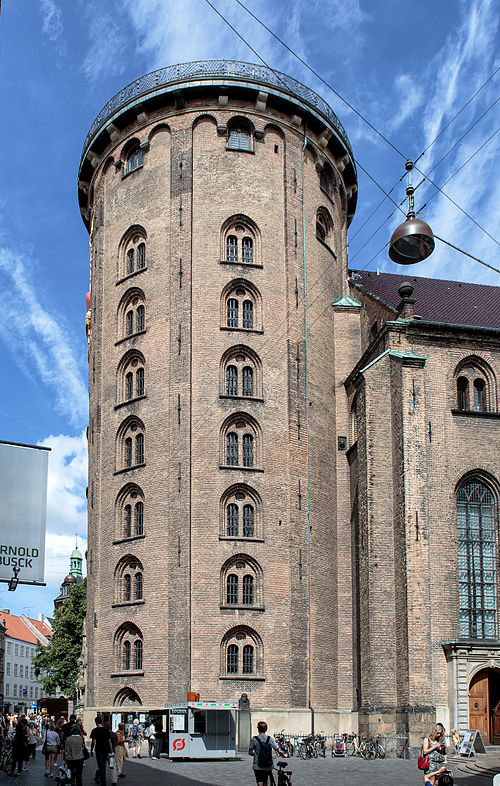
The Rundetaarn, or Round Tower, is a 17th-century tower located in central Copenhagen, Denmark. Commissioned by King Christian IV, it was constructed between 1637 and 1642 as part of the Trinitatis Complex, which included a university library, a church, and an astronomical observatory. The structure is renowned for its unique 209-meter-long spiral ramp, which winds 7.5 times around the hollow core of the tower, allowing for the transport of heavy astronomical equipment by horse and carriage.
Standing 34.8 meters tall, the tower serves as the oldest functioning observatory in Europe. While it no longer hosts professional research, it remains a popular site for amateur astronomy and public observation. The top of the tower features an outdoor platform that provides panoramic views of the historic center of Copenhagen, and the building continues to house a gallery and exhibition space in the former library hall.
Key Facts
- Materials
- Brick, Sandstone
- Civilization
- Danish
- Accessibility
- The spiral ramp is accessible, though steep; the final section to the platform requires stairs
- Date(s)
- 1637-1642
- Condition
- Well-preserved and active
- Original Function
- Astronomical observatory, university library, and church tower
- Key Figures
- Christian IV of Denmark, Christen Sørensen Longomontanus, Ole Rømer
Commission and Construction
1637-1642King Christian IV commissioned the tower as part of the Trinitatis Complex to support the University of Copenhagen. The architect Hans van Steenwinckel the Younger designed the structure, incorporating the innovative spiral ramp to facilitate the movement of heavy instruments to the observatory at the summit.
Scientific Significance
17th-18th centuryThe observatory played a crucial role in early modern Danish science. Astronomer Ole Rømer, famous for his first measurement of the speed of light, utilized the tower for his observations. It remained a primary site for academic research until the mid-19th century.
Modern Preservation
20th century-presentFollowing the relocation of professional astronomical research to modern facilities, the Rundetaarn was repurposed for public education and tourism. It was designated as a protected monument in 1932 and continues to host cultural exhibitions and public stargazing events.
Cultural Significance
The Rundetaarn is a symbol of Copenhagen's architectural heritage and the scientific ambitions of the Danish Golden Age. Its design, characterized by the absence of stairs, is a unique feature of 17th-century engineering that has become an iconic element of the city's skyline. It remains a central point of interest for both locals and visitors, representing the intersection of academic history and public space.
Interpretive Notes
Scholarly debates and areas of uncertainty
There is occasional academic discussion regarding the extent to which the tower's design was influenced by contemporary Dutch architectural trends versus the specific requirements of the university's astronomical needs. Additionally, the exact original configuration of the library hall's interior remains a subject of study due to multiple renovations over the centuries.
Visiting Information
Entry Rules
Open daily. Tickets are required for entry. The tower is a popular tourist site; visitors are advised to check the official website for seasonal opening hours and potential closures for private events.
Best Times to Visit
Early morning or late afternoon on weekdays to avoid peak tourist crowds. The tower is particularly popular during clear evenings when the observatory is open for public stargazing.
Photography
Personal photography is permitted throughout the tower. Commercial photography requires prior authorization from the administration.
Preservation Notes
The spiral ramp is original and uneven in places; visitors should wear comfortable footwear. The tower is a historic site and should be treated with care; do not lean on or climb the exterior masonry.
Nearby POIs
11 shownSources & Further Reading
- [1]The Round Tower: A History — Erik Kjersgaard. Copenhagen City Museum Press (1992)
- [2]Christian IV and the Architecture of the Trinitatis Complex — Hanne Raabyemagle. Danish Architectural Press (2005)
Key Facts
- Materials
- Brick, Sandstone
- Civilization
- Danish
- Accessibility
- The spiral ramp is accessible, though steep; the final section to the platform requires stairs
- Date(s)
- 1637-1642
- Condition
- Well-preserved and active
- Original Function
- Astronomical observatory, university library, and church tower
- Key Figures
- Christian IV of Denmark, Christen Sørensen Longomontanus, Ole Rømer