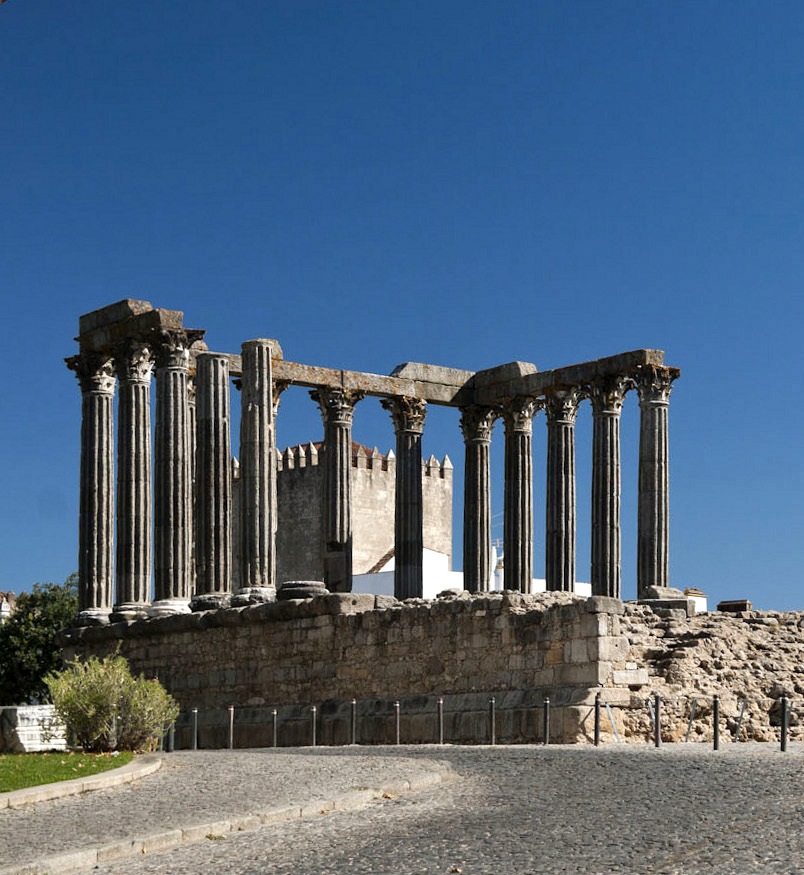
The Roman Temple of Évora, often referred to as the Temple of Diana, is a well-preserved ancient Roman structure located in the historic center of Évora, Portugal. Constructed in the 1st century CE, it stands as one of the most significant Roman monuments in the Iberian Peninsula and serves as a central feature of the city's UNESCO World Heritage-listed historic core.
The temple is a peripteral structure built on a high podium, featuring Corinthian columns made of local granite with marble bases and capitals. Although its original dedication remains a subject of historical speculation, the site has survived through centuries of repurposing, including use as a fortress, a theater, and a slaughterhouse, which paradoxically contributed to its preservation.
Key Facts
- Materials
- Granite, Estremoz marble
- Civilization
- Roman
- Accessibility
- Open-air public square, fully accessible
- Date(s)
- 1st century CE
- Condition
- Partially ruined, well-preserved podium and colonnade
- Original Function
- Temple
- Key Figures
- Augustus
Construction and Early Use
1st century CEThe temple was built during the reign of Augustus or shortly thereafter in the Roman city of Liberalitas Julia (modern-day Évora). It served as the religious center of the forum, dedicated to the imperial cult.
Medieval Repurposing
5th-15th centuryFollowing the fall of the Roman Empire, the temple was integrated into the medieval walls of the city. It was converted into a fortress in the 14th century, which involved walling in the columns, a modification that protected the structure from total destruction.
Modern Restoration
19th century - presentIn the 19th century, the medieval additions were removed to reveal the original Roman architecture. Archaeological excavations in the 20th century further clarified the temple's layout and its relationship to the surrounding forum.
Cultural Significance
The temple is a symbol of Évora's Roman heritage and its status as a major administrative center in the province of Lusitania. It represents the Romanization of the Iberian Peninsula and the integration of local urban centers into the imperial religious framework.
Locally, the site is deeply embedded in the city's identity, often referred to as the 'Temple of Diana' due to a 17th-century legend, despite no archaeological evidence linking it to the goddess. It remains a focal point for tourism and cultural events in the Alentejo region.
Interpretive Notes
Scholarly debates and areas of uncertainty
The primary scholarly debate concerns the original deity to whom the temple was dedicated. While traditionally called the Temple of Diana, most historians now agree it was likely dedicated to the Imperial Cult, specifically to Augustus or a later emperor, given its location in the forum.
Visiting Information
Entry Rules
The temple is located in a public square and is accessible 24 hours a day. There is no entry fee.
Best Times to Visit
Early morning or late afternoon to avoid the intense Alentejo sun and to view the columns in softer light.
Photography
None. Public space.
Preservation Notes
The site is protected as a national monument. Visitors should refrain from climbing on the podium or touching the ancient marble capitals.
Nearby POIs
0 shownNo nearby POIs listed yet.
Sources & Further Reading
- [1]The Roman Temple of Évora — Direção-Geral do Património Cultural. Património Cultural Portugal (2020)View
- [2]Roman Architecture in the Iberian Peninsula — T.W. Potter. Cambridge University Press (1995)
Key Facts
- Materials
- Granite, Estremoz marble
- Civilization
- Roman
- Accessibility
- Open-air public square, fully accessible
- Date(s)
- 1st century CE
- Condition
- Partially ruined, well-preserved podium and colonnade
- Original Function
- Temple
- Key Figures
- Augustus
Nearby POIs
0 shownNo nearby POIs listed yet.