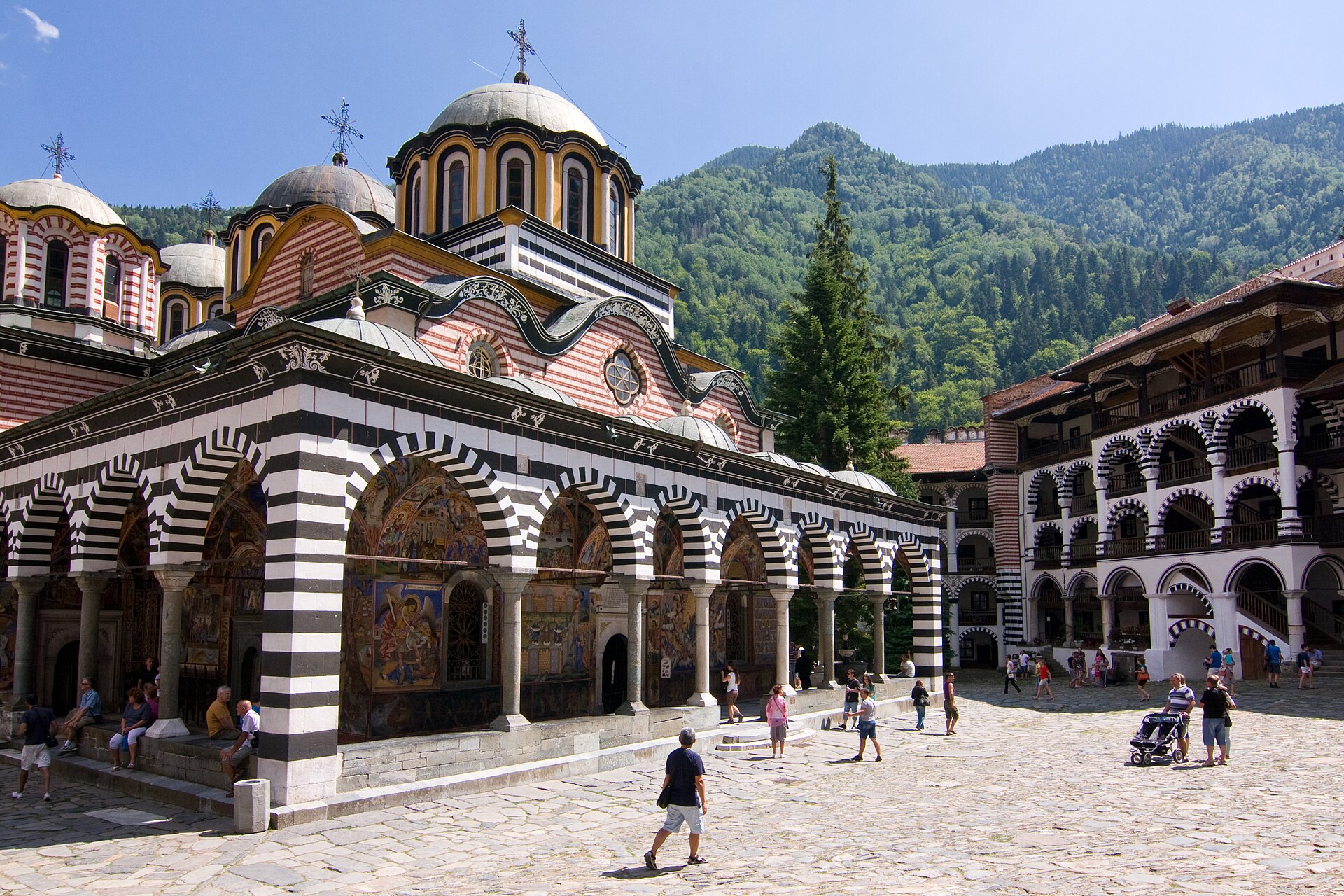
Rila Monastery is an Eastern Orthodox monastic complex located in the Rila Mountains of southwestern Bulgaria, approximately 120 kilometers south of Sofia. Founded in the 10th century by the hermit Saint Ivan of Rila, the monastery developed into one of the most important spiritual and cultural centers of medieval Bulgaria. Over the centuries it served as a center of religious scholarship, manuscript production, and Bulgarian national identity during periods of Byzantine and Ottoman rule. The present architectural complex largely dates to the 19th century Bulgarian National Revival following a destructive fire in 1833. Its enclosed courtyard is surrounded by arcaded residential buildings and dominated by the Church of the Nativity of the Virgin, renowned for its extensive frescoes and iconostasis. The monastery remains an active religious community and is widely regarded as one of the most significant monuments of Bulgarian cultural heritage.
Key Facts
- Materials
- Stone, Brick, Wood, Plaster
- Civilization
- Bulgarian
- Date(s)
- 10th century; major reconstruction 1834–1862
- Condition
- Well-preserved active monastery and major cultural monument
- Original Function
- Eastern Orthodox monastic community
- Key Figures
- Saint Ivan of Rila, Alexiy Rilets, Zahari Zograf
Foundation by Saint Ivan of Rila
10th centuryThe origins of the monastery are tied to the hermit Saint Ivan of Rila, who lived as an ascetic in the Rila Mountains during the 10th century. After his death, followers established a monastic community near the cave where he had lived. The monastery gradually developed into a spiritual center for the Bulgarian Orthodox Church and became closely associated with the cult of Saint Ivan, whose relics were widely venerated.
Medieval Development
12th–14th centuriesDuring the Second Bulgarian Empire the monastery expanded and received patronage from Bulgarian rulers and aristocrats. It gained land holdings and became an important center of literacy, religious education, and manuscript copying. Pilgrims visited the site to venerate the relics of Saint Ivan of Rila, strengthening the monastery’s religious authority across the region.
Ottoman Period and Cultural Role
15th–18th centuriesFollowing the Ottoman conquest of Bulgaria in the late 14th century, the monastery continued to function as a major religious and cultural institution. Monks preserved Bulgarian language, religious traditions, and historical memory through manuscript copying and education. The monastery also maintained connections with Orthodox communities throughout the Balkans.
Reconstruction in the Bulgarian National Revival
19th centuryA major fire in 1833 destroyed much of the medieval complex. Reconstruction began soon afterward as part of the broader Bulgarian National Revival movement. The new complex, completed between the 1830s and 1860s, included large residential wings surrounding a central courtyard and the richly decorated Church of the Nativity of the Virgin. Artists such as Zahari Zograf contributed extensive fresco cycles that remain among the most important examples of Bulgarian Revival art.
Modern Preservation and UNESCO Recognition
20th century – presentRila Monastery became a symbol of Bulgarian cultural identity in the modern era. It was designated a national monument and underwent conservation work during the 20th century. In 1983 the monastery was inscribed as a UNESCO World Heritage Site, recognizing its architectural significance and its historical role in preserving Bulgarian religious and cultural traditions.
Cultural Significance
Rila Monastery has long functioned as one of the most important spiritual centers of the Bulgarian Orthodox world. During centuries of foreign rule, particularly under the Ottoman Empire, it served as a place where Bulgarian religious practice, language, and literary traditions were preserved. Monks maintained scriptoria and schools, ensuring the transmission of ecclesiastical texts and cultural memory. In modern Bulgaria the monastery is widely regarded as a symbol of national identity and religious heritage. Pilgrimages to the relics of Saint Ivan of Rila remain common, and the complex continues to operate as an active monastery. Its architecture and fresco decoration also represent a major expression of the Bulgarian National Revival period, linking religious devotion with the cultural movement that contributed to the country’s modern national consciousness.
Visiting Information
Entry Rules
Open daily. The monastery complex and main church are open to visitors. The monastic museum operates on regular daytime hours and requires an in-person purchase of a separate ticket.
Best Times to Visit
Early morning offers quieter access before large tour groups arrive. Late spring and early autumn provide milder weather in the Rila Mountains while the monastery remains fully accessible.
Photography
Personal photography is permitted in the courtyard and exterior areas. Photography may be restricted inside certain chapels or museum rooms, and flash is generally discouraged.
Preservation Notes
Visitors should remain on marked pathways within the courtyard and surrounding grounds. Some sections of the monastery complex are reserved for the resident monastic community and are not open to the public.
Nearby POIs
0 shownNo nearby POIs listed yet.
Sources & Further Reading
- [1]
- [2]Rila Monastery and the Bulgarian National Revival — John D. Bell. East European Monographs (1998)
- [3]The Monasteries of Bulgaria — Ivan Mitev. Bulgarian Academy of Sciences (2002)
Key Facts
- Materials
- Stone, Brick, Wood, Plaster
- Civilization
- Bulgarian
- Date(s)
- 10th century; major reconstruction 1834–1862
- Condition
- Well-preserved active monastery and major cultural monument
- Original Function
- Eastern Orthodox monastic community
- Key Figures
- Saint Ivan of Rila, Alexiy Rilets, Zahari Zograf
Nearby POIs
0 shownNo nearby POIs listed yet.