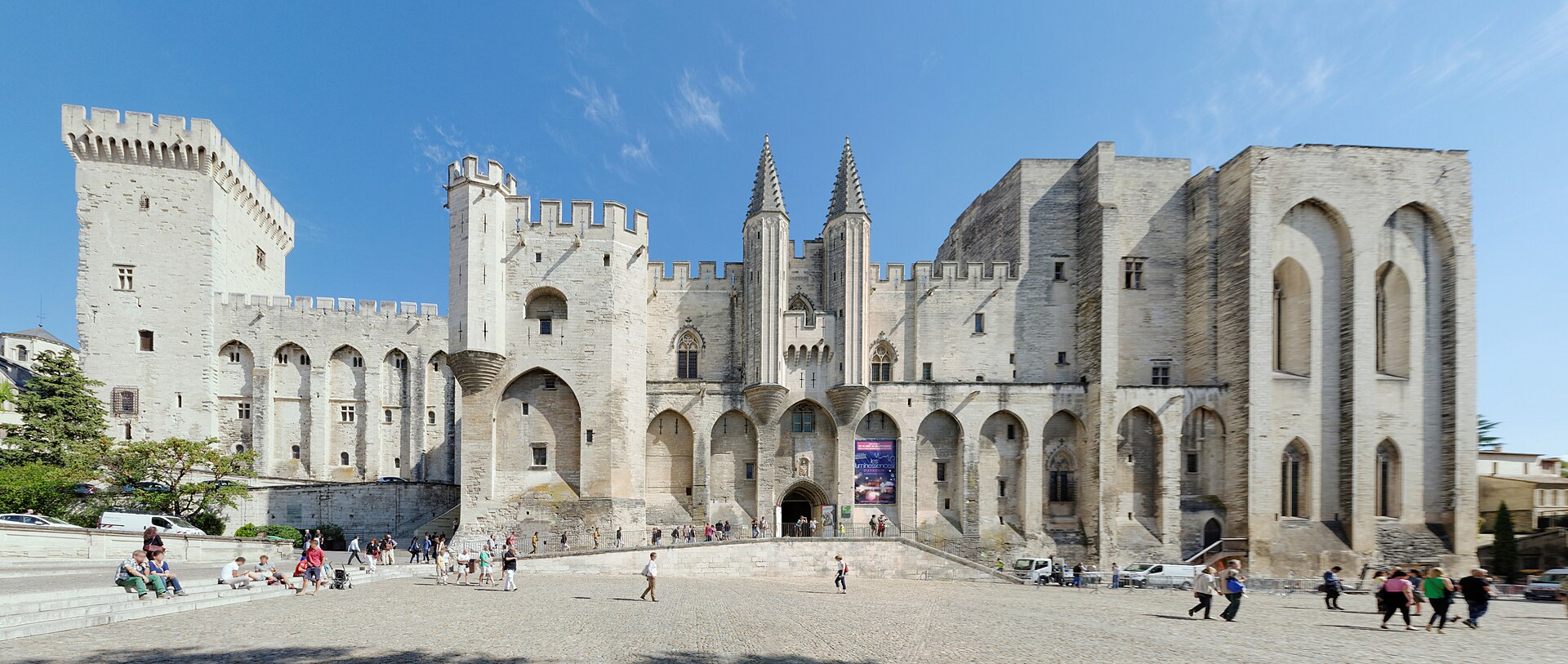
The Palais des Papes, located in Avignon, France, is one of the largest and most significant medieval Gothic buildings in Europe. Constructed during the 14th century, it served as the seat of Western Christianity during the Avignon Papacy, a period when seven successive popes resided in the city rather than Rome. The fortress-like structure is divided into two main sections: the Palais Vieux, built by Pope Benedict XII, and the Palais Neuf, added by his successor, Clement VI.
The palace functioned as both a fortified residence and the administrative center of the Catholic Church. Its massive walls, soaring towers, and intricate interior chapels reflect the immense wealth and political influence of the papacy during the 14th century. Despite being partially stripped of its furnishings during the French Revolution, the palace remains a primary example of medieval architecture and a testament to the complex political history of the Avignon Papacy.
Key Facts
- Materials
- Limestone, Stone masonry
- Civilization
- Medieval European
- Accessibility
- Partially accessible; some areas involve steep stairs and uneven stone floors
- Date(s)
- 1335 - 1364
- Condition
- Well-preserved, open as a museum and cultural venue
- Original Function
- Papal residence and administrative center
- Key Figures
- Pope Benedict XII, Pope Clement VI, Pope Urban V
Establishment of the Avignon Papacy
1309Pope Clement V moved the papal court to Avignon in 1309, seeking to escape the political instability and violence in Rome. The city remained the center of the Catholic Church for nearly seventy years.
Construction of the Palais Vieux
1335-1342Pope Benedict XII commissioned the construction of the Palais Vieux, a fortress-like structure designed to serve as a secure residence for the papacy. This phase established the core defensive architecture of the site.
Expansion and the Palais Neuf
1342-1352Pope Clement VI expanded the complex significantly by adding the Palais Neuf, which included grand ceremonial halls and private apartments, reflecting the increasing opulence of the papal court.
Decline and French Revolution
17th-18th centuryFollowing the return of the papacy to Rome, the palace fell into disrepair. During the French Revolution, the building was seized by the state and used as a barracks and prison, leading to the destruction of much of its interior decoration.
Modern Restoration
1906 - presentThe palace was classified as a historical monument in 1840 and underwent extensive restoration starting in the early 20th century. Today, it is managed as a major heritage site and cultural center.
Cultural Significance
The Palais des Papes symbolizes a unique era in ecclesiastical history where the center of the Catholic world shifted away from its traditional seat in Rome. It represents the height of Avignon's influence as a European political and cultural hub during the 14th century.
Today, the palace is a cornerstone of Avignon's identity and a major site for international tourism. It is also famous for hosting the annual Festival d'Avignon, one of the world's most prominent performing arts festivals, which utilizes the palace's grand courtyard as a primary stage.
Interpretive Notes
Scholarly debates and areas of uncertainty
Historians continue to debate the extent to which the Avignon Papacy was a 'Babylonian Captivity' controlled by the French monarchy versus a strategic move to ensure the survival of the Church. Additionally, the original layout of the interior frescoes and the specific function of certain chambers remain subjects of ongoing archaeological investigation.
Visiting Information
Entry Rules
Open daily. Tickets are required for entry. Visitors are advised to book in advance during peak tourist seasons. Modest dress is recommended for the chapel areas.
Best Times to Visit
Early morning or late afternoon to avoid peak crowds. The site is particularly significant during the summer months when the Avignon Festival takes place.
Photography
Personal photography is permitted in most areas without flash. Tripods and commercial equipment require prior authorization.
Preservation Notes
The site is fragile; visitors must stay on marked paths and avoid touching the walls or frescoes. Restoration work is ongoing in various sections of the palace.
Nearby POIs
0 shownNo nearby POIs listed yet.
Sources & Further Reading
- [1]The Avignon Papacy: The Popes in Exile 1305-1403 — Yves Renouard. Faber & Faber (1970)
- [2]Palais des Papes: A Guide to the Monument — Dominique Vingtain. Editions du Patrimoine (2015)
Key Facts
- Materials
- Limestone, Stone masonry
- Civilization
- Medieval European
- Accessibility
- Partially accessible; some areas involve steep stairs and uneven stone floors
- Date(s)
- 1335 - 1364
- Condition
- Well-preserved, open as a museum and cultural venue
- Original Function
- Papal residence and administrative center
- Key Figures
- Pope Benedict XII, Pope Clement VI, Pope Urban V
Nearby POIs
0 shownNo nearby POIs listed yet.