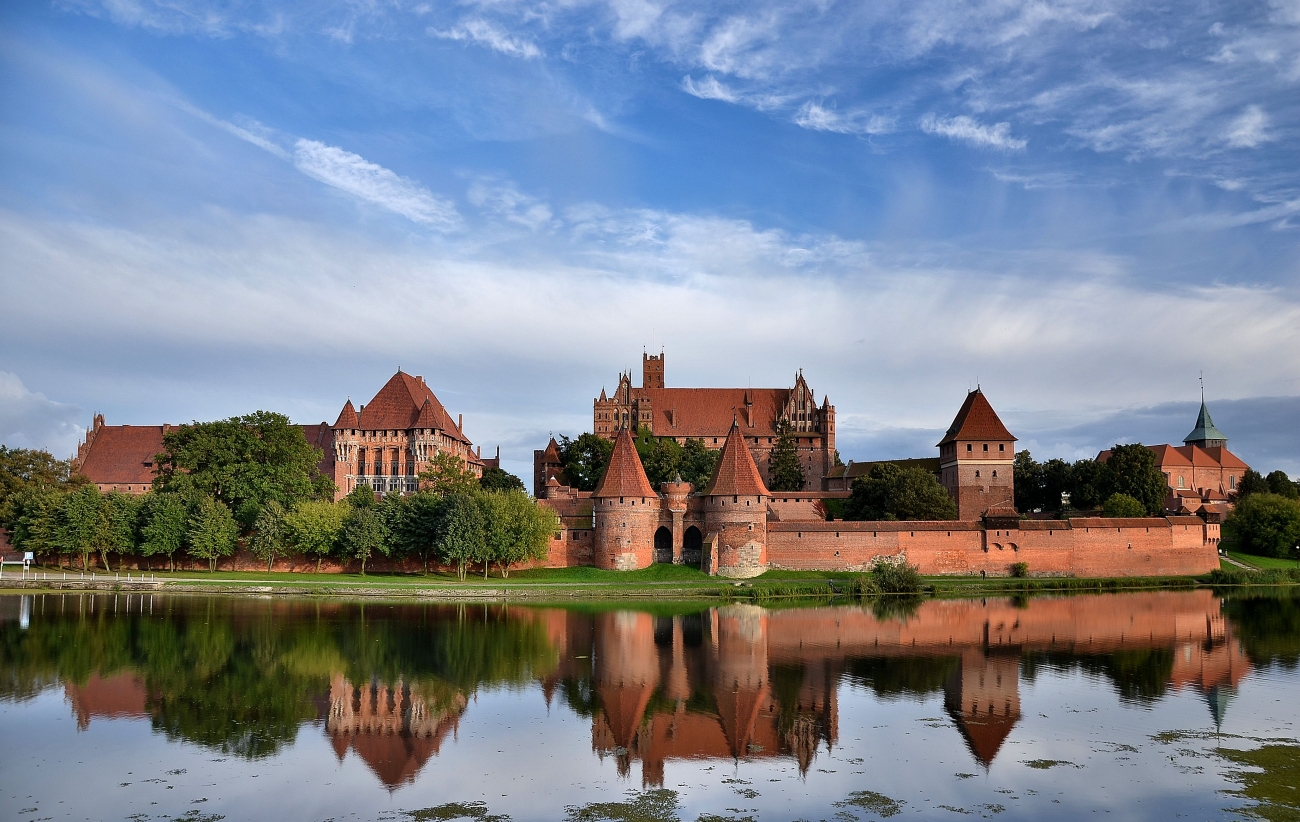
Malbork Castle, or the Castle of the Teutonic Order in Malbork, is a 13th-century Teutonic castle and fortress located near the town of Malbork in northern Poland. It is recognized as the largest castle in the world by land area and is a quintessential example of Brick Gothic architecture. The complex was built in several stages by the Teutonic Knights after their conquest of Old Prussia, serving as the seat of the Grand Master of the Order.
The fortress consists of three main sections: the High, Middle, and Lower Castles, separated by dry moats and towers. Following the Thirteen Years' War, the castle became a residence of the Polish kings. Today, it functions as a museum and is a significant site for historical research and tourism, reflecting the complex geopolitical shifts of the Baltic region over the last eight centuries.
Key Facts
- Materials
- Brick, Stone
- Civilization
- Teutonic Order
- Accessibility
- Partially accessible; some areas involve uneven terrain and stairs
- Date(s)
- 1274–1406
- Condition
- Extensively restored after World War II damage
- Original Function
- Fortified monastery and seat of the Grand Master
- Key Figures
- Siegfried von Feuchtwangen, Casimir IV Jagiellon
Founding and Expansion
1274–1309The castle was founded by the Teutonic Knights in 1274 on the banks of the Nogat River. Originally named Marienburg, it grew rapidly in importance, becoming the administrative center of the Order's state in 1309 when the Grand Master moved his headquarters from Venice.
The Teutonic Zenith
14th centuryDuring the 14th century, the castle reached its peak as a military and religious hub. It was expanded significantly to accommodate the growing number of knights and the administrative needs of the Order's expanding territory.
Polish Rule
1457–1772Following the Thirteen Years' War, the castle was pledged to the Polish Crown in 1457. It served as one of the residences of the Polish kings and a strategic military outpost during the Polish-Lithuanian Commonwealth era.
Destruction and Restoration
1945–presentThe castle suffered severe damage during the final stages of World War II. Post-war efforts focused on massive reconstruction and restoration, leading to its inscription as a UNESCO World Heritage site in 1997.
Cultural Significance
Malbork Castle serves as a primary symbol of the Teutonic Order's historical influence in the Baltic region. It represents the intersection of religious military orders, medieval defensive engineering, and the shifting borders of Central Europe. For Poland, it is a site of national heritage, symbolizing the historical reclamation of territories and the preservation of medieval architectural legacy.
Beyond its national importance, the site is a global reference point for Brick Gothic architecture. Its preservation status and the scale of its post-war reconstruction are frequently cited in international conservation studies regarding the ethics and techniques of rebuilding war-damaged monuments.
Interpretive Notes
Scholarly debates and areas of uncertainty
Debates persist regarding the extent of the 19th and 20th-century 'romantic' reconstructions, with some scholars arguing that certain additions were based on idealized interpretations of Gothic style rather than strict archaeological evidence. Additionally, the role of the castle as a site of German versus Polish national identity remains a subject of historical discourse.
Visiting Information
Entry Rules
Open daily. Tickets are required for entry and can be purchased online or at the box office. Guided tours are recommended due to the vast size of the complex. Visitors are advised to wear comfortable walking shoes.
Best Times to Visit
Late spring and early autumn offer the best weather for exploring the extensive outdoor courtyards. Weekdays are significantly less crowded than weekends.
Photography
Personal photography is permitted in most areas. Flash photography is prohibited inside the museum galleries and the amber collection.
Preservation Notes
The site is subject to ongoing conservation. Some areas may be restricted due to maintenance. Please refrain from touching the brickwork or historical artifacts.
Nearby POIs
8 shownSources & Further Reading
- [1]
- [2]The Teutonic Knights: A Military History — William Urban. Greenhill Books (2003)
Key Facts
- Materials
- Brick, Stone
- Civilization
- Teutonic Order
- Accessibility
- Partially accessible; some areas involve uneven terrain and stairs
- Date(s)
- 1274–1406
- Condition
- Extensively restored after World War II damage
- Original Function
- Fortified monastery and seat of the Grand Master
- Key Figures
- Siegfried von Feuchtwangen, Casimir IV Jagiellon