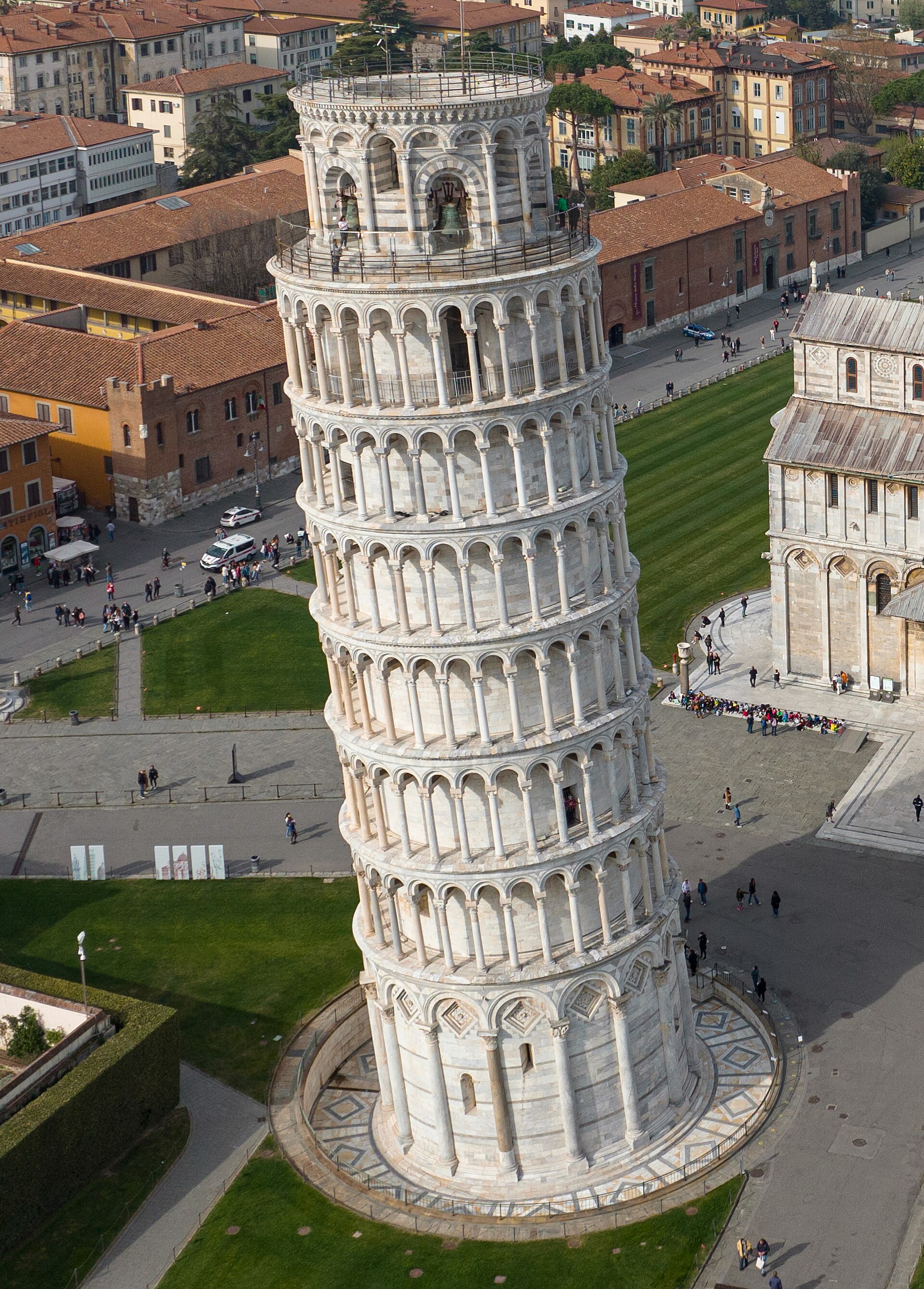
The Leaning Tower of Pisa is the campanile, or freestanding bell tower, of the cathedral of the Italian city of Pisa. It is situated behind the Pisa Cathedral and is the third-oldest structure in the city's Cathedral Square, following the cathedral and the baptistery.
The tower's tilt began during construction in the 12th century, caused by an inadequate foundation on ground too soft on one side to properly support the structure's weight. The tilt increased in the decades before the structure was completed and gradually increased until the structure was stabilized by remedial work in the late 20th and early 21st centuries.
Key Facts
- Materials
- White marble, Limestone
- Civilization
- Italian (Pisan Republic)
- Accessibility
- Not wheelchair accessible; requires climbing 251 steps
- Date(s)
- 1173–1372
- Condition
- Stabilized; open for guided tourist visits
- Original Function
- Bell tower for the Cathedral of Santa Maria Assunta
- Key Figures
- Bonanno Pisano, Diotisalvi, Giovanni di Simone
Initial Construction
1173–1178Construction began in August 1173. After the third story was built in 1178, the tower began to sink due to the unstable subsoil, leading to a century-long halt in construction.
Resumption and Completion
1272–1372Construction resumed in 1272 under Giovanni di Simone. To compensate for the tilt, engineers built upper floors with one side taller than the other. The belfry was finally added in 1372.
Stabilization Efforts
1990–2001The tower was closed to the public in 1990 for major structural reinforcement. Soil extraction from beneath the north side successfully reduced the tilt by 45 centimeters, ensuring the tower's safety for the future.
Cultural Significance
The tower is a global icon of architectural error and resilience. It serves as the centerpiece of the Piazza dei Miracoli, a site that reflects the maritime power and artistic ambition of the medieval Republic of Pisa. Its unintended lean has made it one of the most recognizable structures in the world, influencing popular culture and engineering studies alike.
Interpretive Notes
Scholarly debates and areas of uncertainty
There is ongoing academic discussion regarding the original architect. While traditionally attributed to Bonanno Pisano, some scholars suggest Diotisalvi, who designed the nearby baptistery, based on stylistic similarities in the masonry.
Visiting Information
Entry Rules
Timed-entry tickets are required. Visitors must be at least 8 years old. Large bags are not permitted inside and must be left at the cloakroom.
Best Times to Visit
Early morning or late afternoon to avoid peak cruise ship crowds. The site is less congested during the shoulder seasons of spring and autumn.
Photography
Personal photography is permitted. Tripods are prohibited inside the tower due to space constraints.
Preservation Notes
Visitors must follow the designated path. The marble surfaces are fragile; do not lean on or touch the interior walls.
Nearby POIs
0 shownNo nearby POIs listed yet.
Sources & Further Reading
- [1]The Leaning Tower of Pisa: A Study of its Structural History — John Burland. ICE Publishing (2008)View
- [2]Pisa: The Cathedral Square — Enrico Castelnuovo. Electa (2001)
Key Facts
- Materials
- White marble, Limestone
- Civilization
- Italian (Pisan Republic)
- Accessibility
- Not wheelchair accessible; requires climbing 251 steps
- Date(s)
- 1173–1372
- Condition
- Stabilized; open for guided tourist visits
- Original Function
- Bell tower for the Cathedral of Santa Maria Assunta
- Key Figures
- Bonanno Pisano, Diotisalvi, Giovanni di Simone
Nearby POIs
0 shownNo nearby POIs listed yet.