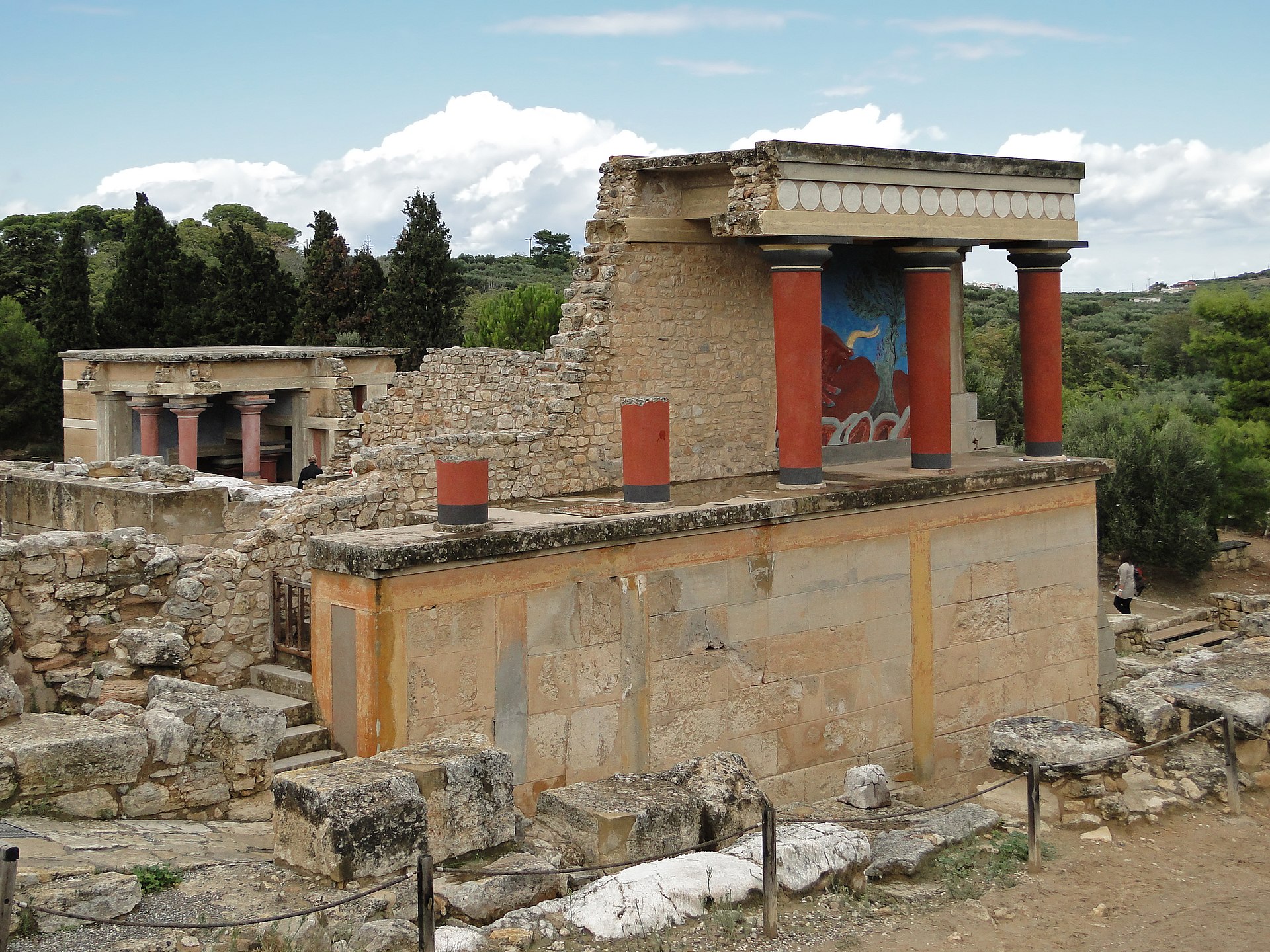
Knossos is the largest Bronze Age archaeological site on Crete and has been described as Europe's oldest city. It served as the ceremonial and political center of the Minoan civilization, reaching its peak during the Neopalatial period between 1700 and 1450 BCE. The site is characterized by its complex layout, multi-story structures, and sophisticated drainage systems, which distinguish it from contemporary settlements in the Aegean.
The site gained international prominence following the excavations led by Sir Arthur Evans in the early 20th century. Evans' controversial reconstruction of the palace, utilizing reinforced concrete to stabilize and interpret the ruins, remains a focal point of archaeological discourse regarding the ethics and accuracy of site restoration.
Key Facts
- Materials
- Limestone, Gypsum, Timber, Terracotta
- Civilization
- Minoan
- Accessibility
- Partial accessibility; some areas feature uneven terrain and stairs
- Date(s)
- c. 1900 BCE - 1450 BCE
- Condition
- Partially reconstructed ruins
- Original Function
- Palatial administrative and religious center
- Key Figures
- Sir Arthur Evans, Minos, Daedalus
Early Foundations
7000 - 3000 BCEThe site was first settled during the Neolithic period. Excavations reveal a continuous habitation sequence, with the earliest structures dating back to the 7th millennium BCE, establishing it as a significant regional hub long before the rise of the palace culture.
The Protopalatial Period
1900 - 1700 BCEThe first palace was constructed around 1900 BCE. This period saw the development of the characteristic central court layout and the establishment of Knossos as a dominant power in Crete, though the structure was largely destroyed by seismic activity.
The Neopalatial Zenith
1700 - 1450 BCEFollowing the destruction, a larger, more complex palace was built. This era represents the height of Minoan influence, characterized by elaborate frescoes, extensive storage magazines, and the development of Linear A script.
Mycenaean and Roman Eras
1450 BCE - 4th century CEFollowing the decline of Minoan power, the site was occupied by Mycenaeans who utilized the palace for administrative purposes. Later, during the Roman period, Knossos became a colony, and the site continued to function as a significant urban center.
Modern Excavation
1900 - 1935 CESir Arthur Evans began systematic excavations in 1900. His extensive and often speculative reconstruction of the palace walls and frescoes defined the modern visitor experience but sparked long-standing debates regarding archaeological integrity.
Cultural Significance
Knossos is inextricably linked to the Greek myth of King Minos, the Labyrinth, and the Minotaur. This mythological association has profoundly influenced Western literature and art, framing the site as a place of mystery and ancient complexity. It serves as the primary reference point for understanding Minoan culture and its foundational role in European civilization.
Interpretive Notes
Scholarly debates and areas of uncertainty
The primary debate concerns Sir Arthur Evans' reconstruction methods. Critics argue that his use of concrete and his interpretation of the site's layout were overly imaginative, potentially obscuring the original archaeological evidence. Additionally, the exact nature of the Minoan political structure—whether it was a centralized monarchy or a more decentralized religious confederation—remains a subject of ongoing academic inquiry.
Visiting Information
Entry Rules
Open daily. Tickets can be purchased at the entrance or online. Visitors are advised to arrive early to avoid peak cruise ship crowds. No specific dress code, but comfortable walking shoes are essential.
Best Times to Visit
Early morning (before 9:00) or late afternoon to avoid the intense Cretan sun and large tour groups. Spring and autumn offer the most temperate weather for exploring the open-air site.
Photography
Personal photography is permitted. Tripods and professional equipment require prior authorization from the Hellenic Ministry of Culture.
Preservation Notes
The site is fragile; stay strictly within marked paths. Do not touch the frescoes or structural remains. Restoration work is ongoing, and some areas may be temporarily cordoned off for maintenance.
Nearby POIs
3 shownSources & Further Reading
- [1]
- [2]Knossos: A Labyrinth of History — C.F. Macdonald. British School at Athens (2005)
Key Facts
- Materials
- Limestone, Gypsum, Timber, Terracotta
- Civilization
- Minoan
- Accessibility
- Partial accessibility; some areas feature uneven terrain and stairs
- Date(s)
- c. 1900 BCE - 1450 BCE
- Condition
- Partially reconstructed ruins
- Original Function
- Palatial administrative and religious center
- Key Figures
- Sir Arthur Evans, Minos, Daedalus