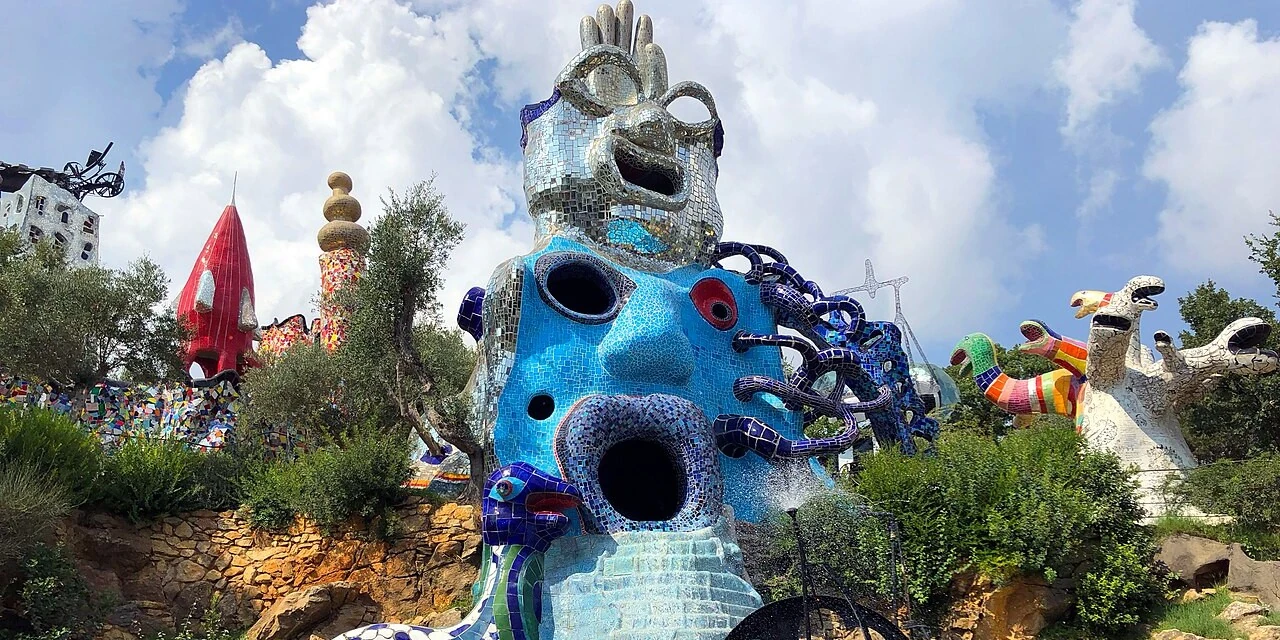
The Giardino dei Tarocchi is a monumental sculpture garden located in Pescia Fiorentina, Tuscany, featuring twenty-two large-scale structures inspired by the major arcana of the Tarot deck. Conceived and constructed by French-American artist Niki de Saint Phalle, the project was heavily influenced by Antoni Gaudí’s Park Güell in Barcelona and the Parco dei Mostri in Bomarzo.
Spanning over two hectares, the garden was built between 1979 and 1998. The sculptures are constructed from reinforced concrete and finished with intricate mosaics composed of glass, mirrors, and ceramics. The site serves as both an immersive art installation and a reflection of the artist's personal philosophical and spiritual journey.
Key Facts
- Materials
- Reinforced concrete, Ceramic tiles, Mirror fragments, Colored glass
- Civilization
- Contemporary Italian
- Accessibility
- Limited due to uneven terrain and stairs
- Date(s)
- 1979-1998
- Condition
- Well-maintained, open seasonally
- Original Function
- Artistic installation and private garden
- Key Figures
- Niki de Saint Phalle, Jean Tinguely
Conception and Inspiration
1970sNiki de Saint Phalle began conceptualizing the garden after visiting the Parco dei Mostri in Bomarzo. She sought to create a 'garden of joy' that integrated sculpture with the natural landscape, drawing thematic inspiration from the symbolic imagery of Tarot cards.
Construction Phase
1979-1998Construction began in 1979 on land provided by the Caracciolo family. Saint Phalle worked with a team of local craftsmen and international artists, including her husband Jean Tinguely, who contributed metal structures for the sculptures. The process was self-funded and spanned nearly two decades.
Public Opening
1998The garden was officially opened to the public in 1998. Since its inauguration, it has been managed by the Fondazione Il Giardino dei Tarocchi, which ensures the ongoing maintenance of the mosaics and the structural integrity of the figures.
Cultural Significance
The Giardino dei Tarocchi is a significant example of environmental art and the 'outsider art' tradition. It represents a unique synthesis of architecture, sculpture, and esoteric symbolism, reflecting the feminist and spiritual themes prevalent in Saint Phalle's later career. The garden has become a landmark of contemporary art in Tuscany, attracting visitors interested in the intersection of landscape design and surrealist aesthetics.
Interpretive Notes
Scholarly debates and areas of uncertainty
Debates often center on the classification of the garden within the art historical canon, specifically whether it should be viewed primarily as a sculptural park or as an architectural environment. Additionally, scholars discuss the extent to which the garden functions as a 'total work of art' (Gesamtkunstwerk) versus a collection of individual, distinct sculptural pieces.
Visiting Information
Entry Rules
Open seasonally from April 1st to October 15th. Tickets must be purchased in advance via the official website. Visitors are required to follow marked paths to protect the mosaic surfaces.
Best Times to Visit
Spring and early autumn offer the most temperate weather for walking the garden. Mid-summer can be extremely hot due to the lack of shade in certain areas of the park.
Photography
Personal photography is permitted for non-commercial use. Tripods and professional equipment require prior authorization from the foundation.
Preservation Notes
The mosaic surfaces are fragile; visitors are strictly prohibited from touching or climbing on the sculptures. Stay on designated paths to avoid damaging the surrounding vegetation and the base of the installations.
Nearby POIs
0 shownNo nearby POIs listed yet.
Sources & Further Reading
- [1]Niki de Saint Phalle: The Tarot Garden — Niki de Saint Phalle. Benteli (1999)
- [2]Niki de Saint Phalle: Life and Work — Jill Carrick. University of Chicago Press (2017)
Key Facts
- Materials
- Reinforced concrete, Ceramic tiles, Mirror fragments, Colored glass
- Civilization
- Contemporary Italian
- Accessibility
- Limited due to uneven terrain and stairs
- Date(s)
- 1979-1998
- Condition
- Well-maintained, open seasonally
- Original Function
- Artistic installation and private garden
- Key Figures
- Niki de Saint Phalle, Jean Tinguely
Nearby POIs
0 shownNo nearby POIs listed yet.