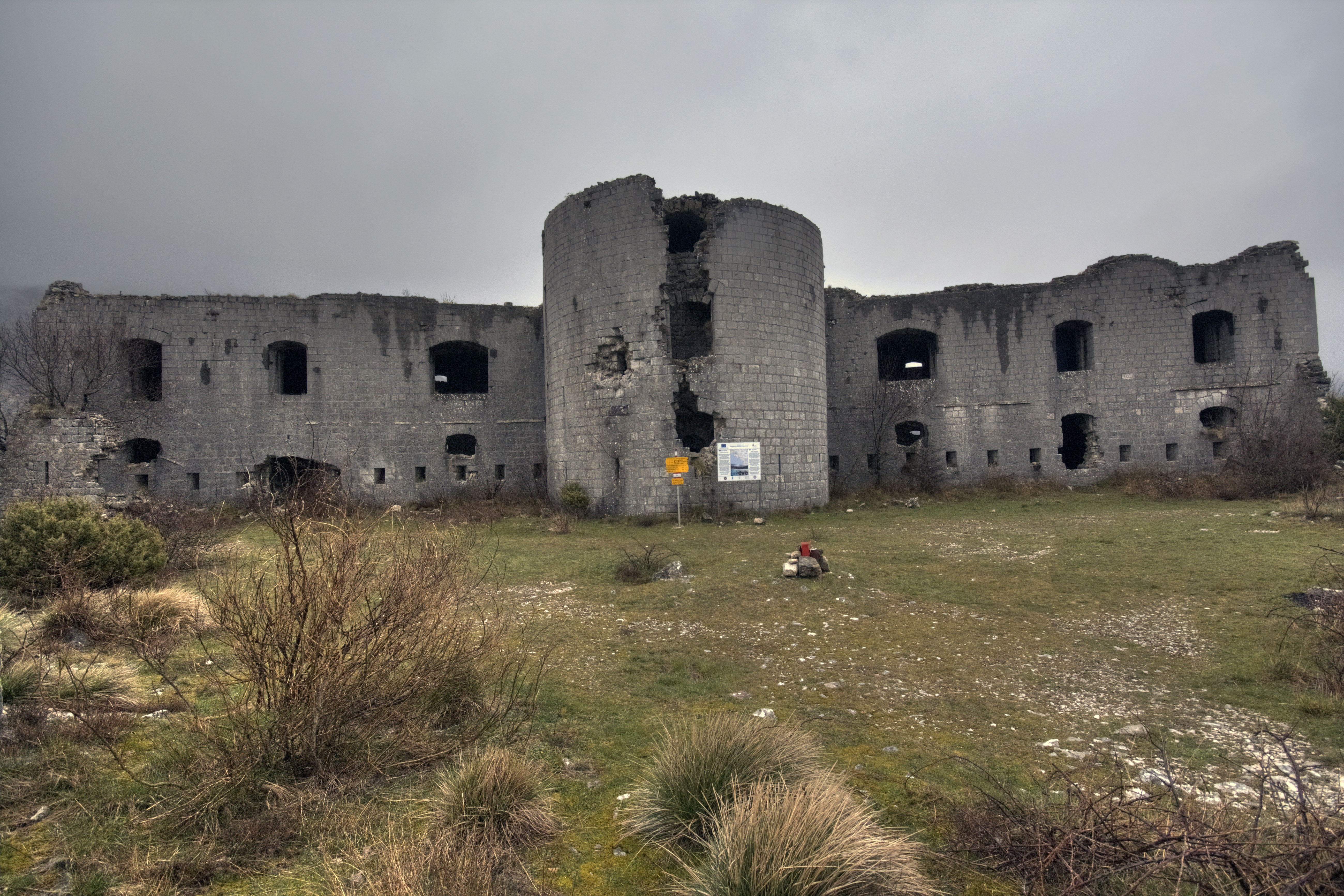
Fort Kosmač is a 19th-century Austro-Hungarian fortification located near the village of Brajići in Montenegro. Positioned at an elevation of approximately 800 meters, the fort was constructed to command the strategic mountain pass connecting the coastal town of Kotor with the historical capital of Cetinje. It served as a critical defensive node for the Austro-Hungarian Empire, designed to monitor and control movement through the rugged terrain of the Montenegrin hinterland.
The structure is built primarily of local stone and features a multi-level design typical of the period's military architecture. Although it has suffered significant structural degradation due to neglect and exposure to the elements, the fort remains a prominent landmark. It stands as a testament to the geopolitical tensions between the Austro-Hungarian Empire and the Principality of Montenegro during the late 19th century.
Key Facts
- Materials
- Local limestone, Mortar
- Civilization
- Austro-Hungarian
- Accessibility
- Accessible via hiking trail from Brajići
- Date(s)
- 1841-1850
- Condition
- Ruined, partially collapsed
- Original Function
- Military fortification and border control
- Key Figures
Strategic Construction
1841-1850The fort was commissioned by the Austro-Hungarian military to secure the border region and maintain control over the vital trade and military route between the Bay of Kotor and the Montenegrin interior.
Military Utility
Late 19th CenturyDuring its active years, the fort housed a garrison tasked with monitoring the border and suppressing potential insurgencies. Its position allowed for clear visibility of the surrounding mountains and the Adriatic coastline.
Abandonment and Decay
20th Century - PresentFollowing the dissolution of the Austro-Hungarian Empire and the changing political landscape of the Balkans, the fort lost its military relevance. It was subsequently abandoned and has since fallen into a state of advanced disrepair, with significant portions of the roof and interior walls having collapsed.
Cultural Significance
Fort Kosmač represents the historical intersection of the Austro-Hungarian Empire's expansionist policies and the resistance of local Montenegrin populations. It serves as a physical reminder of the complex border dynamics that defined the region during the 19th century.
Interpretive Notes
Scholarly debates and areas of uncertainty
There is ongoing discussion among local historians regarding the potential for partial restoration versus maintaining the site as a stabilized ruin to preserve its historical authenticity.
Visiting Information
Entry Rules
The site is open to the public at all times. No entry fees apply. Visitors should exercise caution as the structure is unstable.
Best Times to Visit
Spring and autumn are ideal for hiking to the site, as summer temperatures can be extreme and the path is exposed.
Photography
None. Personal photography is permitted.
Preservation Notes
The structure is in a state of advanced decay. Visitors are advised not to enter the interior chambers due to the risk of falling masonry.
Nearby POIs
11 shownSources & Further Reading
- [1]Austro-Hungarian Fortifications in the Adriatic — Robert M. Johnston. Military History Review (2012)
- [2]The Montenegrin Borderlands: A Historical Survey — Dragan Vuković. Balkan Heritage Press (2018)
Key Facts
- Materials
- Local limestone, Mortar
- Civilization
- Austro-Hungarian
- Accessibility
- Accessible via hiking trail from Brajići
- Date(s)
- 1841-1850
- Condition
- Ruined, partially collapsed
- Original Function
- Military fortification and border control
- Key Figures