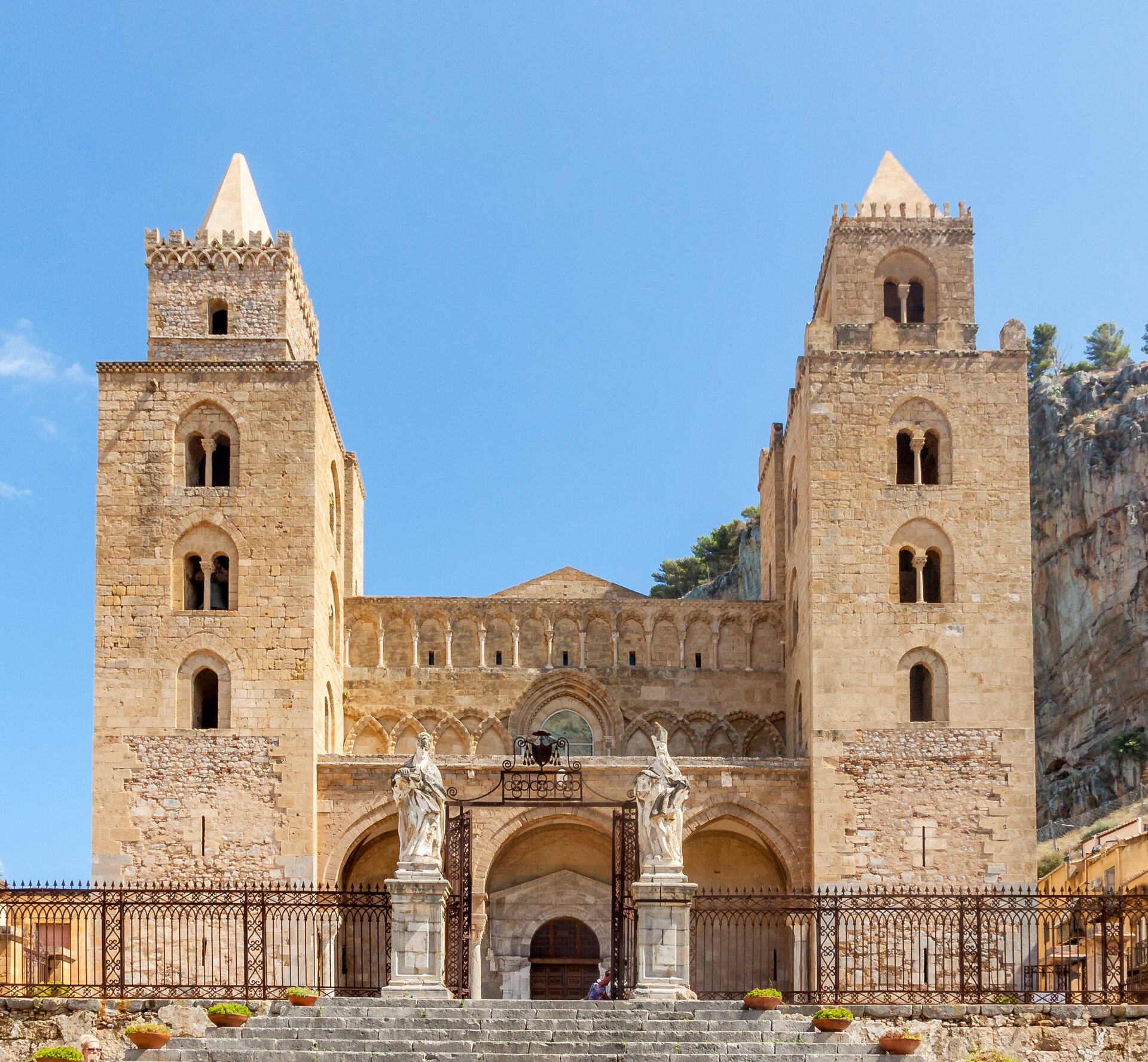
The Cathedral of Cefalù is a major Norman architectural landmark located in the town of Cefalù, Sicily. Commissioned by King Roger II in 1131, the structure is renowned for its imposing twin towers and its synthesis of Norman, Arab, and Byzantine architectural styles. It serves as a primary example of the Arab-Norman style that characterizes much of Sicily's medieval heritage.
The interior is dominated by a massive apse featuring a celebrated mosaic of Christ Pantocrator, executed by Byzantine craftsmen. The cathedral remains an active place of worship and is part of the UNESCO World Heritage site designated as 'Arab-Norman Palermo and the Cathedral Churches of Cefalù and Monreale.'
Key Facts
- Materials
- Limestone, Gold leaf tesserae, Marble
- Civilization
- Norman-Sicilian
- Accessibility
- Ground floor accessible, some steps to altar areas
- Date(s)
- 1131 - 1240 CE
- Condition
- Well-preserved, active cathedral
- Original Function
- Cathedral and Royal Mausoleum
- Key Figures
- Roger II of Sicily, Frederick II
Foundation and Construction
1131According to legend, King Roger II vowed to build a magnificent church after surviving a storm at sea and landing safely on the beach of Cefalù. Construction began in 1131, with the choir and apse completed first to serve as a royal mausoleum.
Byzantine Artistic Integration
1145 - 1148During the mid-12th century, Roger II invited master mosaicists from Constantinople to decorate the apse. The resulting Christ Pantocrator is considered one of the finest examples of Byzantine mosaic art in the Mediterranean.
Completion and Modifications
13th - 15th centuryThe nave and facade were completed by 1240. Over the following centuries, the cathedral underwent minor structural additions, including the 15th-century portico added to the western facade.
Modern Restoration
20th century - presentThe cathedral has undergone several major restoration campaigns to stabilize the masonry and preserve the delicate Byzantine mosaics. In 2015, it was inscribed as a UNESCO World Heritage site.
Cultural Significance
The cathedral represents the unique cultural syncretism of 12th-century Sicily, where Norman rulers employed Greek, Arab, and Latin artisans. It stands as a testament to the religious and political ambitions of the Hauteville dynasty, serving as both a spiritual center and a symbol of royal authority in the Mediterranean.
Locally, the cathedral is the heart of Cefalù's identity, anchoring the town's historic center against the backdrop of the La Rocca mountain. It remains a focal point for both religious pilgrimage and international cultural tourism.
Interpretive Notes
Scholarly debates and areas of uncertainty
There is ongoing academic discussion regarding the extent of Islamic influence on the cathedral's structural design, particularly the pointed arches and the layout of the transept. While clearly Romanesque in its overall plan, the integration of Fatimid-style decorative elements remains a subject of study regarding the cross-cultural exchange of the era.
Visiting Information
Entry Rules
Open daily. Entry to the main nave is free, though a ticket is required to access the cloister and the upper terraces. Modest dress is strictly required (shoulders and knees covered).
Best Times to Visit
Early morning or late afternoon to avoid the intense Sicilian sun and peak cruise ship crowds. Spring and autumn offer the most comfortable temperatures for exploring the surrounding historic district.
Photography
Photography is permitted without flash. Tripods and professional video equipment require prior authorization from the ecclesiastical authorities.
Preservation Notes
The mosaics are extremely fragile; do not use flash photography. Maintain silence as this is an active place of worship. Stay within designated visitor areas.
Nearby POIs
0 shownNo nearby POIs listed yet.
Key Facts
- Materials
- Limestone, Gold leaf tesserae, Marble
- Civilization
- Norman-Sicilian
- Accessibility
- Ground floor accessible, some steps to altar areas
- Date(s)
- 1131 - 1240 CE
- Condition
- Well-preserved, active cathedral
- Original Function
- Cathedral and Royal Mausoleum
- Key Figures
- Roger II of Sicily, Frederick II
Nearby POIs
0 shownNo nearby POIs listed yet.