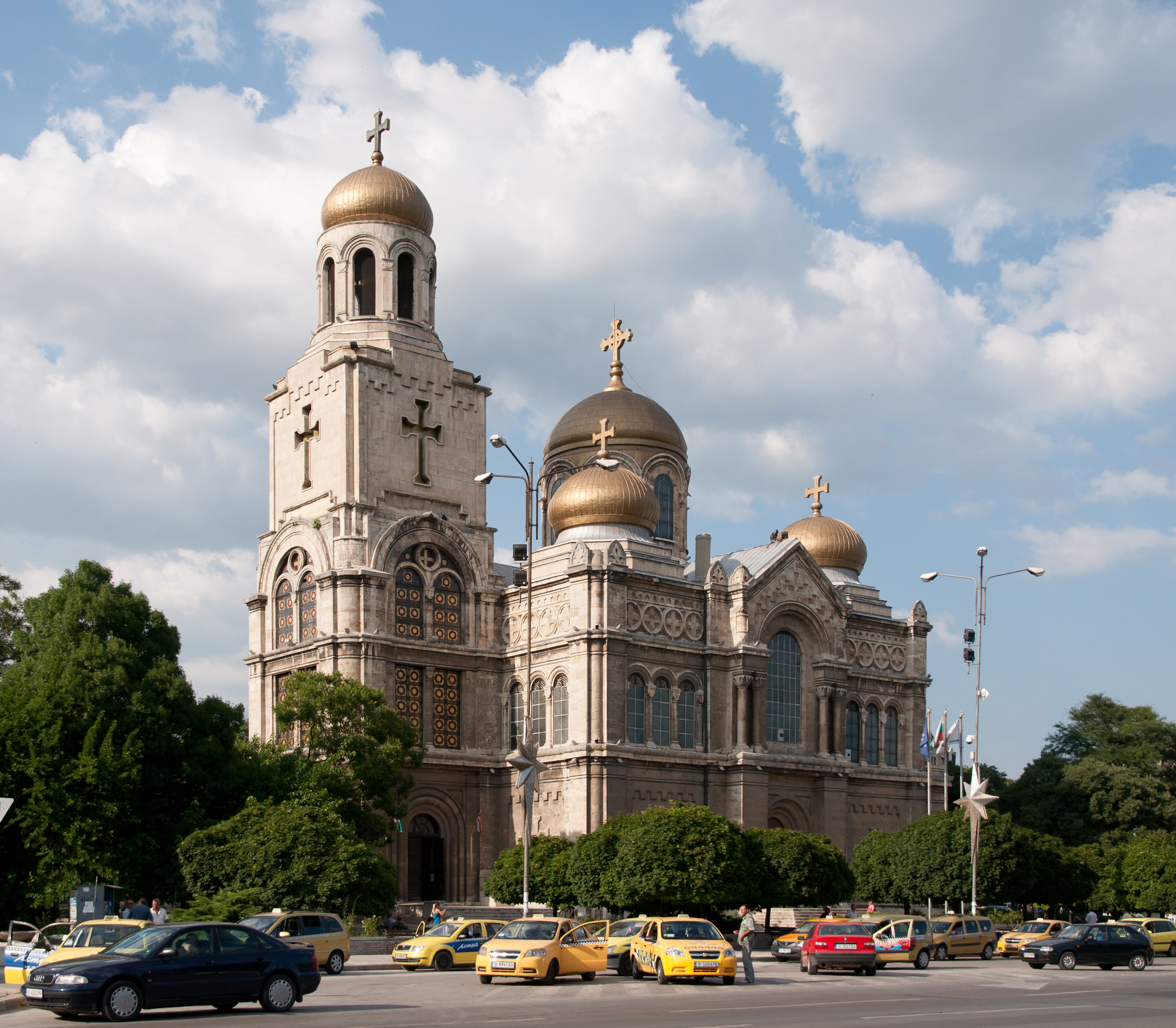
The Dormition of the Mother of God Cathedral is the largest and most famous Bulgarian Orthodox cathedral in Varna. Construction began in 1880, shortly after Bulgaria's liberation from Ottoman rule, and it was consecrated in 1886. The cathedral serves as the seat of the Bishopric of Varna and Veliki Preslav and is a central landmark of the city.
The architectural design is heavily influenced by the Neo-Byzantine style, characterized by its distinctive golden domes and a tall bell tower that offers panoramic views of the city. The interior features elaborate wood carvings, a bishop's throne, and a series of murals and stained glass windows added during the 20th century.
Key Facts
- Materials
- Stone, Brick, Copper, Gold leaf
- Civilization
- Bulgarian
- Accessibility
- Ground level accessible, limited interior mobility
- Date(s)
- 1880-1886
- Condition
- Active religious site, well-maintained
- Original Function
- Orthodox Cathedral
- Key Figures
- Prince Alexander I of Bulgaria, Metropolitan Simeon of Varna
Foundation and Construction
1880-1886The foundation stone was laid by Prince Alexander I of Bulgaria in 1880. The project was funded through public donations and a lottery, reflecting the national pride of the newly liberated Bulgarian state.
Architectural Development
1900-1950While the structure was completed in 1886, the interior decoration continued for decades. The iconic murals and the stained glass windows were installed in the mid-20th century to enhance the liturgical space.
Modern Restoration
2000-presentIn recent years, the cathedral underwent significant exterior restoration, including the gilding of the domes and the installation of a new lighting system that highlights the building's silhouette at night.
Cultural Significance
The cathedral is a symbol of Varna's post-liberation identity and the resurgence of Bulgarian Orthodox culture. It serves as the primary site for major religious celebrations and state ceremonies in the region, acting as a focal point for the local community.
Interpretive Notes
Scholarly debates and areas of uncertainty
There is minor academic discussion regarding the extent of the influence of the Peterhof Palace church in Saint Petersburg on the cathedral's design, as the architect Mass had studied in Russia.
Visiting Information
Entry Rules
Open daily to the public. Free entry. Visitors are expected to dress modestly, covering shoulders and knees. Silence should be maintained during services.
Best Times to Visit
Early morning or late afternoon to avoid peak tourist traffic. The cathedral is particularly atmospheric during major Orthodox holidays like Easter.
Photography
Photography is permitted without flash. Professional photography or video equipment requires prior permission from the church administration.
Preservation Notes
The cathedral is an active place of worship; please respect the sanctity of the space. Do not touch the icons or murals.
Nearby POIs
8 shownSources & Further Reading
- [1]The Cathedral of the Assumption of the Virgin in Varna — Varna Municipality. Official Varna Tourism Portal (2021)View
- [2]Bulgarian Orthodox Architecture — Ivanov, P.. Bulgarian Academy of Sciences (2015)
Key Facts
- Materials
- Stone, Brick, Copper, Gold leaf
- Civilization
- Bulgarian
- Accessibility
- Ground level accessible, limited interior mobility
- Date(s)
- 1880-1886
- Condition
- Active religious site, well-maintained
- Original Function
- Orthodox Cathedral
- Key Figures
- Prince Alexander I of Bulgaria, Metropolitan Simeon of Varna