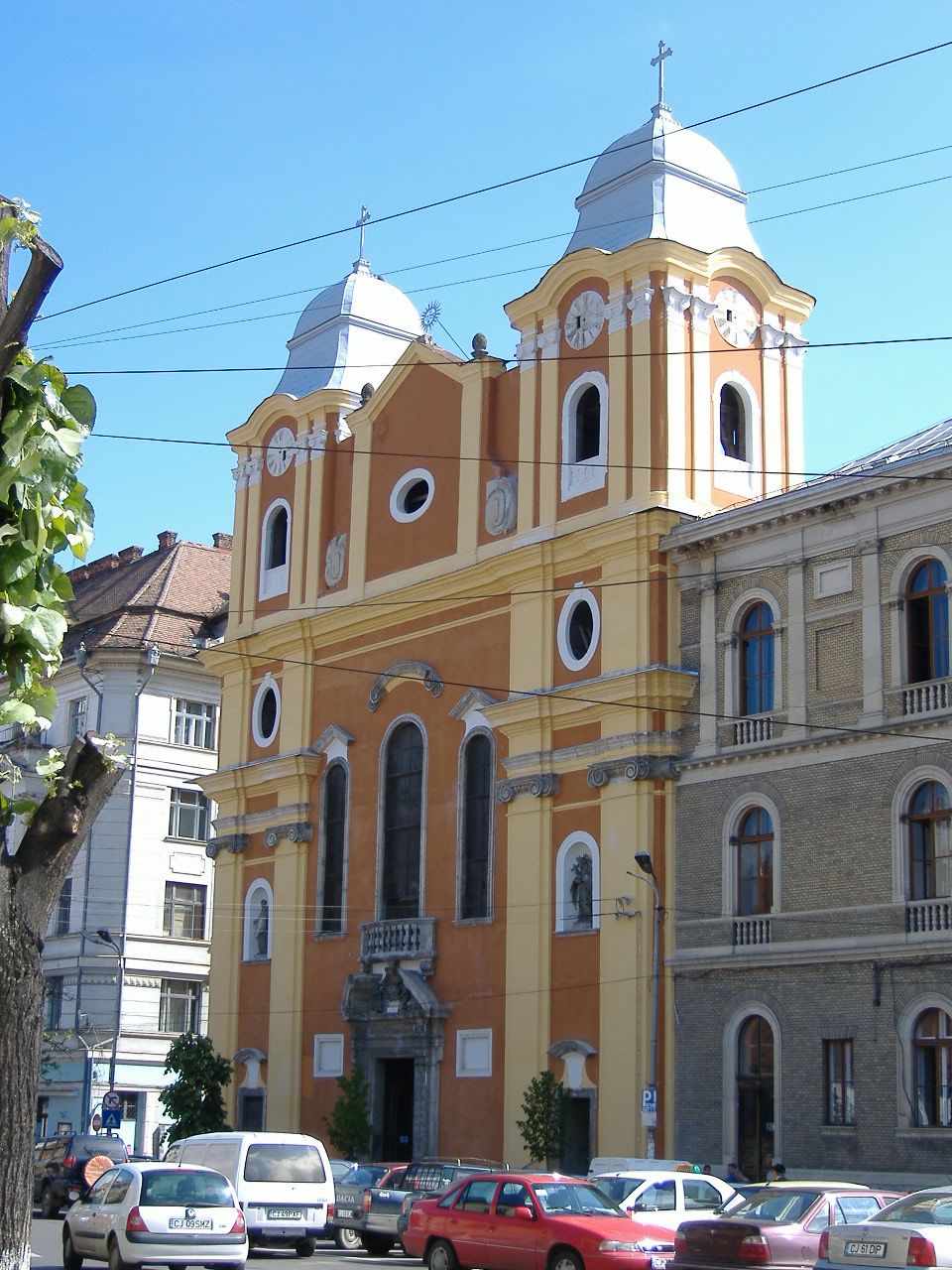
The Piarists' Church in Cluj-Napoca, also known as the Church of the Holy Trinity, is a prominent Baroque religious structure located in the city center. Constructed between 1718 and 1724, it was the first Roman Catholic church built in the city following the Protestant Reformation, serving as a symbol of the Counter-Reformation efforts in Transylvania.
The church was commissioned by the Piarist order, who were invited to Cluj by the Habsburg authorities to revitalize Catholic education and religious life. The architecture features a distinct two-tower facade and an ornate interior, reflecting the transition from late Renaissance influences to the full expression of the Baroque style in the region.
Key Facts
- Materials
- Stone, Brick, Stucco
- Civilization
- Habsburg Monarchy
- Accessibility
- Ground level access, limited interior mobility due to historic layout
- Date(s)
- 1718-1724
- Condition
- Well-preserved, active place of worship
- Original Function
- Catholic Church and educational center
- Key Figures
- Piarist Order
Establishment and Construction
18th CenturyFollowing the consolidation of Habsburg power in Transylvania, the Piarist order was granted land to establish a church and a school. Construction began in 1718, and the church was consecrated in 1724, marking a significant shift in the religious landscape of the city.
Educational Role
18th-19th CenturyThe church was intrinsically linked to the Piarist gymnasium, which became one of the most important educational institutions in the region. The complex served as a hub for both religious instruction and the intellectual development of the local Catholic community.
Modern Era
20th Century - PresentDespite the political changes of the 20th century, the church has remained an active site for the Catholic community. It continues to serve as a landmark of Baroque architecture and a testament to the historical religious diversity of Cluj-Napoca.
Cultural Significance
The Piarists' Church represents the re-establishment of Roman Catholic influence in Cluj-Napoca after a period of Protestant dominance. It stands as a physical manifestation of the Counter-Reformation and the Habsburg administrative influence in Transylvania, playing a crucial role in the city's educational and religious history.
Interpretive Notes
Scholarly debates and areas of uncertainty
Debates exist regarding the extent of the influence of Austrian Baroque architects versus local craftsmen in the execution of the facade and interior decorative elements.
Visiting Information
Entry Rules
Open to the public for services and visitation. Visitors are expected to maintain silence and dress modestly. Entry is free.
Best Times to Visit
Weekday mornings or during scheduled mass times for those interested in the liturgical atmosphere.
Photography
Photography is permitted for personal use without flash. Professional photography requires prior permission from the parish office.
Preservation Notes
The structure is a protected historical monument. Visitors should refrain from touching the altars or historical paintings.
Nearby POIs
7 shownSources & Further Reading
- [1]Cluj-Napoca: The Piarist Church — Lukács József. Transylvanian Review (2005)
- [2]Baroque Architecture in Transylvania — Virgil Vătășianu. Editura Academiei (1970)
Key Facts
- Materials
- Stone, Brick, Stucco
- Civilization
- Habsburg Monarchy
- Accessibility
- Ground level access, limited interior mobility due to historic layout
- Date(s)
- 1718-1724
- Condition
- Well-preserved, active place of worship
- Original Function
- Catholic Church and educational center
- Key Figures
- Piarist Order