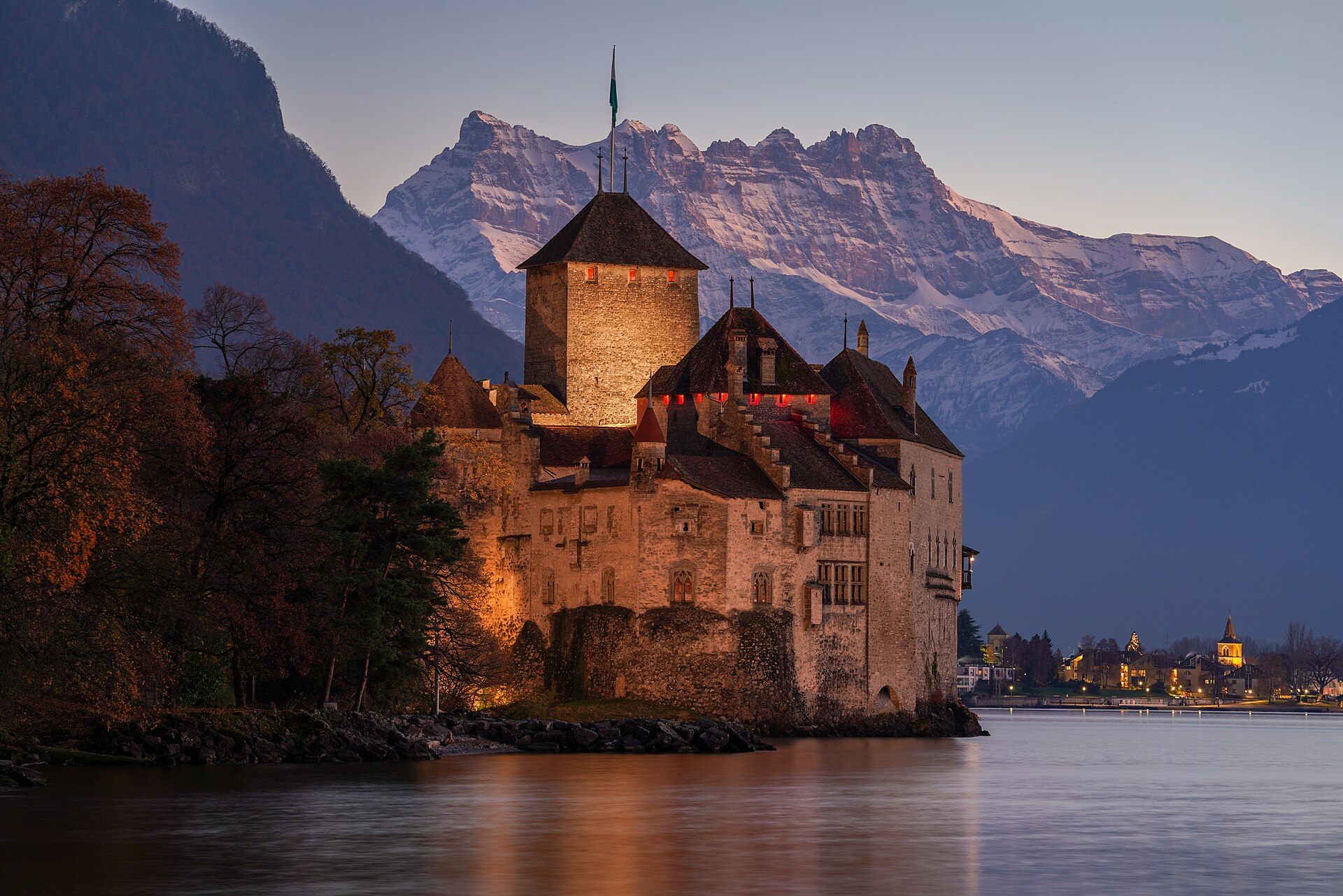
Château de Chillon is an island castle located on the shores of Lake Geneva in Veytaux, Switzerland. The site consists of 25 buildings that were gradually connected to form a single, fortified complex. Its strategic position on a rocky islet provided both a defensive advantage and control over the vital trade route between the northern and southern Alps.
Originally serving as a stronghold for the Counts of Savoy, the castle evolved from a military fortification into a luxurious residence and a state prison. Its architecture reflects centuries of modifications, blending defensive military features with the refined living quarters of the Savoyard nobility, and it remains one of the most visited historical sites in Switzerland.
Key Facts
- Materials
- Limestone, Wood
- Civilization
- Savoyard
- Accessibility
- Partially accessible; some areas involve stairs and uneven stone floors
- Date(s)
- 11th century - 16th century
- Condition
- Well-preserved, museum and heritage site
- Original Function
- Fortress and toll station
- Key Figures
- Peter II of Savoy, François Bonivard
Early Foundations
11th - 12th centuryArchaeological excavations have revealed evidence of Roman and Bronze Age occupation on the site. The earliest stone structures date to the 11th century, serving as a strategic outpost for the Bishop of Sion.
The Savoyard Era
13th - 16th centuryUnder the Counts of Savoy, the castle was significantly expanded. Peter II of Savoy commissioned the architect Pierre Mainier to modernize the fortress, adding the great halls and defensive towers that define its current appearance.
Bernese Occupation
1536 - 1798The Bernese conquered the castle in 1536, liberating the prisoner François Bonivard. During this period, the castle served as a residence for the bailiffs of Vevey and functioned primarily as an arsenal and prison.
Modern Restoration
19th century - presentFollowing the Vaudois Revolution, the castle became state property. Extensive restoration efforts began in the late 19th century, led by architect Albert Naef, to preserve the medieval character of the structure for public visitation.
Cultural Significance
Chillon holds a prominent place in European literature, most notably through Lord Byron's poem 'The Prisoner of Chillon,' which romanticized the imprisonment of François Bonivard. This work brought international attention to the site, cementing its status as a landmark of Romantic-era travel.
Beyond its literary fame, the castle serves as a primary symbol of Swiss heritage and the historical influence of the House of Savoy in the Lake Geneva region. It remains a focal point for regional identity and historical education.
Interpretive Notes
Scholarly debates and areas of uncertainty
There is ongoing academic discussion regarding the exact extent of the Roman-era structures beneath the current foundations. While artifacts have been recovered, the precise layout of the pre-medieval site remains a subject of archaeological interpretation.
Visiting Information
Entry Rules
Open daily except for December 25 and January 1. Tickets can be purchased online or at the entrance. No specific dress code is required, but comfortable footwear is recommended due to uneven stone surfaces.
Best Times to Visit
Early morning or late afternoon to avoid peak tourist groups arriving from Montreux. The site is particularly atmospheric during the autumn months.
Photography
Personal photography is permitted throughout the castle. Tripods and commercial photography require prior authorization from the administration.
Preservation Notes
The castle is a protected monument. Visitors are requested to stay on designated paths and refrain from touching the historical wall paintings and artifacts.
Nearby POIs
0 shownNo nearby POIs listed yet.
Sources & Further Reading
- [1]
- [2]The Counts of Savoy and the Castle of Chillon — Eugene L. Cox. Princeton University Press (1967)
Key Facts
- Materials
- Limestone, Wood
- Civilization
- Savoyard
- Accessibility
- Partially accessible; some areas involve stairs and uneven stone floors
- Date(s)
- 11th century - 16th century
- Condition
- Well-preserved, museum and heritage site
- Original Function
- Fortress and toll station
- Key Figures
- Peter II of Savoy, François Bonivard
Nearby POIs
0 shownNo nearby POIs listed yet.