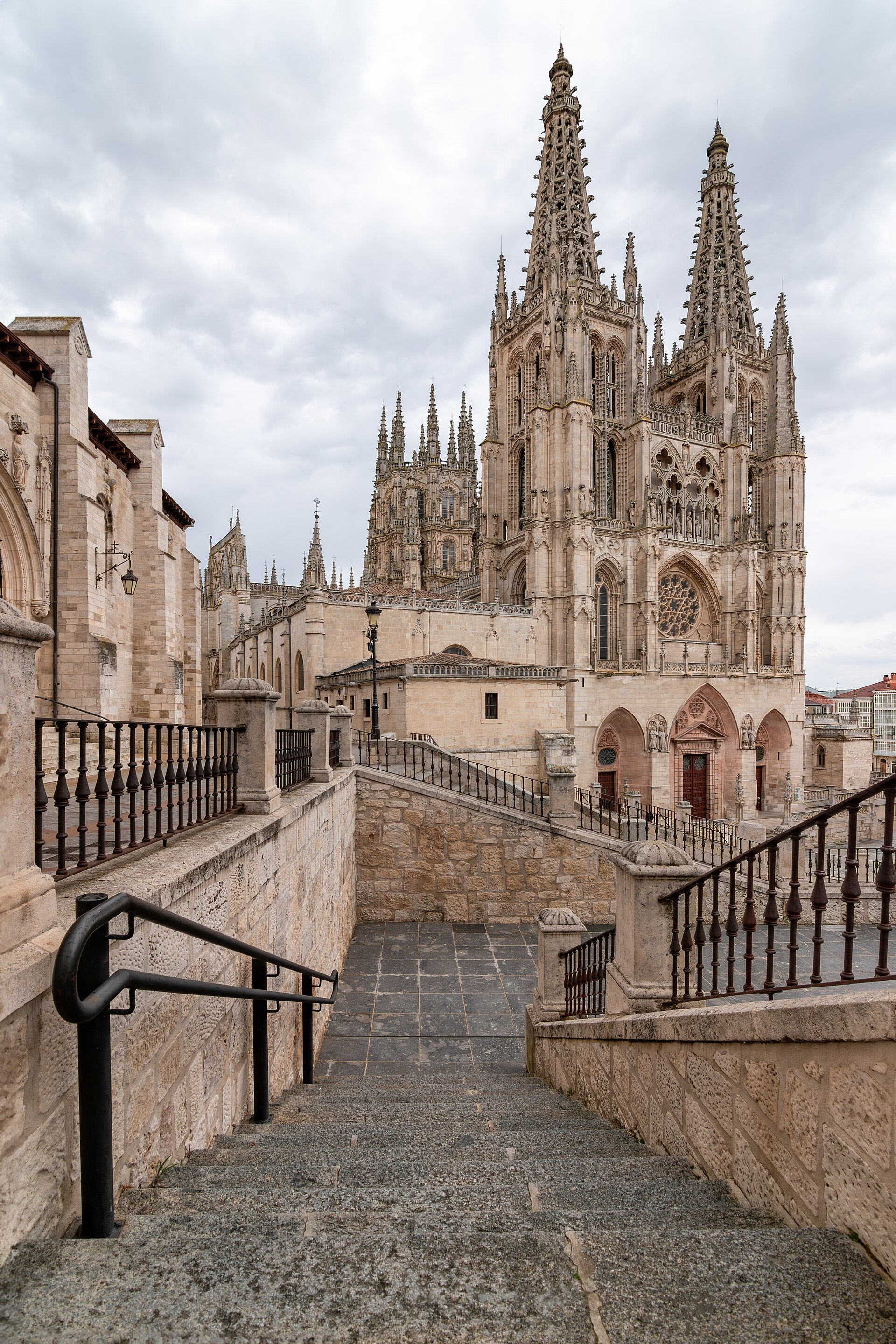
The Cathedral of Saint Mary of Burgos is a masterpiece of Gothic architecture, commissioned by King Ferdinand III of Castile and Bishop Maurice in 1221. It represents the first instance of French Gothic style in the Iberian Peninsula, characterized by its intricate spires, expansive nave, and the octagonal lantern tower added in the 16th century.
The structure serves as a repository of medieval and Renaissance art, housing numerous chapels, a notable golden staircase, and the tomb of the legendary Castilian knight El Cid and his wife, Doña Jimena. Its architectural evolution spans several centuries, incorporating Flamboyant Gothic, Plateresque, and Baroque elements that reflect the shifting artistic priorities of the Spanish monarchy and the Catholic Church.
Key Facts
- Materials
- Limestone
- Civilization
- Castilian
- Accessibility
- Partially accessible; some areas involve stairs
- Date(s)
- 1221 - 1567
- Condition
- Well-preserved, active place of worship
- Original Function
- Catholic Cathedral
- Key Figures
- El Cid, King Ferdinand III, Bishop Maurice, Juan de Colonia
Foundations and Early Gothic
1221-1260Construction began under the patronage of Bishop Maurice, who sought to replace the existing Romanesque cathedral with a structure reflecting the new Gothic style emerging from France. The initial phase focused on the chevet and the ambulatory.
Expansion and Verticality
14th-15th centuryThe cathedral underwent significant expansion, including the construction of the main facade and the addition of the openwork spires by the architect Juan de Colonia, which gave the cathedral its distinctive silhouette.
Renaissance Additions
16th centuryThe crossing was crowned by a magnificent lantern tower, replacing an earlier structure that collapsed. This period also saw the creation of the Golden Staircase (Escalera Dorada) by Diego de Siloé.
Modern Preservation
1984-presentThe cathedral was designated a UNESCO World Heritage Site in 1984. Ongoing conservation efforts focus on the structural integrity of the limestone masonry and the restoration of its extensive collection of stained glass and altarpieces.
Cultural Significance
The Burgos Cathedral is a cornerstone of Spanish national identity, symbolizing the transition of the Kingdom of Castile into a major European power. Its status as the final resting place of El Cid links the site directly to the foundational myths of the Reconquista and the chivalric traditions of medieval Spain.
Beyond its religious function, the cathedral acts as a museum of European art history. It remains a vital stop on the Camino de Santiago, serving as a spiritual and architectural landmark for pilgrims traversing northern Spain.
Interpretive Notes
Scholarly debates and areas of uncertainty
The extent of French influence versus local Castilian adaptation in the cathedral's early design remains a subject of academic discussion. While the floor plan is clearly modeled after French cathedrals like Bourges, the specific decorative techniques and the integration of later Plateresque elements are often cited as evidence of a distinct Spanish Gothic evolution.
Visiting Information
Entry Rules
Open daily for visitors. Tickets are required for entry, with discounts available for pilgrims on the Camino de Santiago. Modest dress is required as it is an active religious site.
Best Times to Visit
Early morning or late afternoon to avoid peak tourist groups. Spring and autumn offer the best light for viewing the interior stained glass.
Photography
Personal photography is permitted without flash or tripods. Professional or commercial photography requires prior authorization from the cathedral administration.
Preservation Notes
Visitors are requested to maintain silence and respect ongoing liturgical services. Do not touch the stone carvings or historical artifacts.
Nearby POIs
0 shownNo nearby POIs listed yet.
Sources & Further Reading
- [1]The Gothic Cathedral: Architecture of the Great Church — Christopher Wilson. Thames & Hudson (2004)
- [2]
Key Facts
- Materials
- Limestone
- Civilization
- Castilian
- Accessibility
- Partially accessible; some areas involve stairs
- Date(s)
- 1221 - 1567
- Condition
- Well-preserved, active place of worship
- Original Function
- Catholic Cathedral
- Key Figures
- El Cid, King Ferdinand III, Bishop Maurice, Juan de Colonia
Nearby POIs
0 shownNo nearby POIs listed yet.