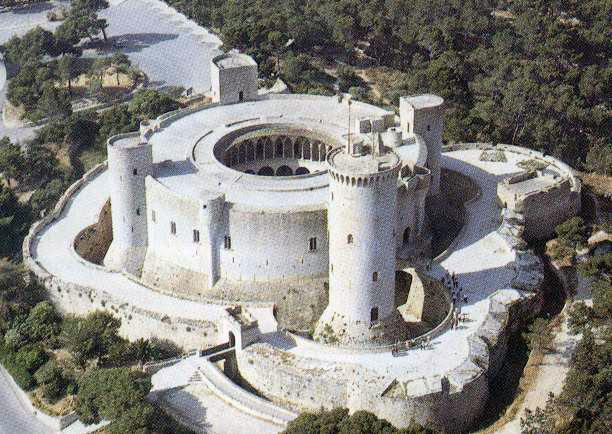
Castell de Bellver is a Gothic-style castle located on a hill overlooking the city of Palma on the island of Majorca, Spain. Built in the early 14th century for King James II of Majorca, it is one of the few circular castles in Europe and serves as a significant example of Mediterranean military architecture.
Following its initial use as a royal residence, the castle functioned as a military prison from the 18th century until the mid-20th century. Today, the structure houses the Palma History Museum and serves as a cultural landmark for the city, offering panoramic views of the Bay of Palma.
Key Facts
- Materials
- Marès sandstone
- Civilization
- Kingdom of Majorca
- Accessibility
- Accessible by road, limited interior mobility due to historic structure
- Date(s)
- 1300-1311
- Condition
- Well-preserved, houses a municipal museum
- Original Function
- Royal residence and defensive fortification
- Key Figures
- James II of Majorca, Gaspar Melchor de Jovellanos
Construction and Royal Use
14th CenturyCommissioned by King James II of Majorca, the castle was designed by architect Pere Salvà. Its unique circular design, featuring three semi-circular towers and a detached keep connected by a bridge, was intended to serve as both a secure royal residence and a defensive stronghold.
Military Prison Era
18th-20th CenturyThe castle transitioned into a long-term military prison. Notable political prisoners held here included the Spanish statesman Gaspar Melchor de Jovellanos and the astronomer François Arago. It remained a site of incarceration through the Spanish Civil War.
Museum and Public Landmark
1931-PresentIn 1931, the castle was ceded to the city of Palma. It was subsequently repurposed as a museum. Extensive restoration efforts have focused on preserving the Gothic arcades and the central courtyard, allowing the site to function as a public space and historical archive.
Cultural Significance
Castell de Bellver is a symbol of Majorcan identity and the island's medieval royal history. Its distinct circular architecture distinguishes it from the typical square-plan fortifications of the period, making it a unique subject of study for architectural historians.
Beyond its architectural value, the site is deeply associated with the history of political dissent in Spain. The long period of its use as a prison has left a complex legacy, shifting from a symbol of royal authority to a site of memory for those imprisoned for their political beliefs.
Interpretive Notes
Scholarly debates and areas of uncertainty
There is ongoing academic discussion regarding the specific defensive efficacy of the circular design compared to contemporary square fortifications. While the design is aesthetically unique, some scholars debate whether the circular geometry was primarily a stylistic choice by the architect or a deliberate tactical innovation for the specific topography of the hill.
Visiting Information
Entry Rules
Open to the public daily. Tickets are required for entry. The site is managed by the Palma City Council, and visitors are expected to adhere to museum conduct rules.
Best Times to Visit
Early morning or late afternoon to avoid peak heat and cruise ship crowds. The site offers clear views of the city, which are best during clear weather conditions.
Photography
Personal photography is permitted in the courtyard and exterior areas. Flash and tripods are prohibited inside the museum galleries.
Preservation Notes
The structure is built from porous marès sandstone, which is sensitive to environmental erosion. Visitors are requested to stay on designated paths and avoid touching the historic masonry.
Nearby POIs
0 shownNo nearby POIs listed yet.
Sources & Further Reading
- [1]Castell de Bellver: History and Architecture — Ajuntament de Palma. Palma City Council Heritage Department (2018)View
- [2]The Gothic Architecture of the Balearic Islands — Mateu Riera. University of the Balearic Islands Press (2012)
Key Facts
- Materials
- Marès sandstone
- Civilization
- Kingdom of Majorca
- Accessibility
- Accessible by road, limited interior mobility due to historic structure
- Date(s)
- 1300-1311
- Condition
- Well-preserved, houses a municipal museum
- Original Function
- Royal residence and defensive fortification
- Key Figures
- James II of Majorca, Gaspar Melchor de Jovellanos
Nearby POIs
0 shownNo nearby POIs listed yet.