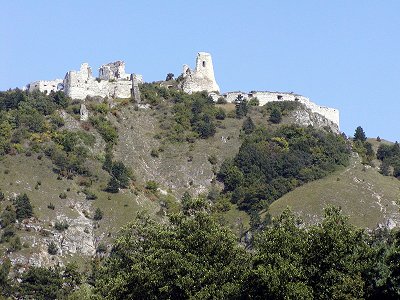
Čachtice Castle is a ruined medieval fortress located on a hill above the village of Čachtice in western Slovakia. Constructed in the 13th century, it served as a strategic defensive fortification protecting the western borders of the Kingdom of Hungary. The castle is situated at an elevation of 375 meters, offering commanding views of the surrounding landscape.
The site is most widely known for its association with Countess Elizabeth Báthory, who resided there during the late 16th and early 17th centuries. Following accusations of extreme cruelty, she was confined to the castle in 1611, where she remained until her death in 1614. Today, the castle exists as a protected cultural monument and a popular destination for historical tourism.
Key Facts
- Materials
- Limestone, Mortar
- Civilization
- Kingdom of Hungary
- Accessibility
- Accessible via hiking trail from Čachtice village
- Date(s)
- 13th century
- Condition
- Ruined, partially stabilized for visitors
- Original Function
- Border defense fortress
- Key Figures
- Elizabeth Báthory, Kazimír Batthyány
Origins and Strategic Role
13th centuryThe castle was built in the mid-13th century by Kazimir of the Hont-Pázmány family. It was designed as a royal watchtower to guard the trade routes leading to Moravia and to secure the western frontier of the Hungarian Kingdom.
The Báthory Era
16th-17th centuryIn the late 16th century, the castle became the primary residence of Countess Elizabeth Báthory. Following investigations into her alleged crimes, she was sentenced to house arrest within the castle walls in 1611, where she spent her final years until her death in 1614.
Decline and Destruction
18th centuryThe castle suffered significant damage during the anti-Habsburg uprisings in the early 18th century, specifically during the Rákóczi War of Independence. By 1708, the fortress was captured and subsequently abandoned, leading to its gradual decay.
Modern Preservation
20th century - presentIn recent decades, the site has undergone extensive archaeological research and structural stabilization. It is currently managed as a heritage site, with ongoing efforts to preserve the remaining masonry and improve visitor infrastructure.
Cultural Significance
Čachtice Castle holds a dual significance as a site of medieval military architecture and as a focal point of European folklore. The legend of the 'Blood Countess' has permeated regional culture, literature, and film, transforming the site into a symbol of historical notoriety.
Beyond its dark reputation, the castle remains a significant example of a hilltop fortification in the Little Carpathians. It serves as a landmark for local heritage and a site of ongoing archaeological study regarding the daily life of the Hungarian nobility during the late Middle Ages.
Interpretive Notes
Scholarly debates and areas of uncertainty
The historical accuracy of the crimes attributed to Elizabeth Báthory remains a subject of debate among historians. Some scholars argue that the accusations were politically motivated by rivals seeking to seize her vast landholdings, while others maintain that the testimonies provided during the 1611 trial reflect genuine historical events.
Visiting Information
Entry Rules
The site is open to the public with a paid admission fee. Visitors are advised to check local seasonal hours, as access may be limited during winter months due to weather conditions.
Best Times to Visit
Late spring and early autumn offer the best conditions for the hike to the summit. Weekdays are recommended to avoid peak weekend crowds.
Photography
Personal photography is permitted throughout the ruins. Commercial filming requires prior authorization from the site management.
Preservation Notes
The site consists of unstable ruins; visitors must remain on designated paths. Climbing on walls or removing stones is strictly prohibited. The area is prone to high winds and sudden weather changes.
Nearby POIs
1 shownSources & Further Reading
- [1]Elizabeth Báthory: The Life and Times of the Blood Countess — Kimberly L. Craft. CreateSpace Independent Publishing (2009)
- [2]Castles of Slovakia: A Historical Guide — Peter Kresánek. Petrus (2009)
Key Facts
- Materials
- Limestone, Mortar
- Civilization
- Kingdom of Hungary
- Accessibility
- Accessible via hiking trail from Čachtice village
- Date(s)
- 13th century
- Condition
- Ruined, partially stabilized for visitors
- Original Function
- Border defense fortress
- Key Figures
- Elizabeth Báthory, Kazimír Batthyány