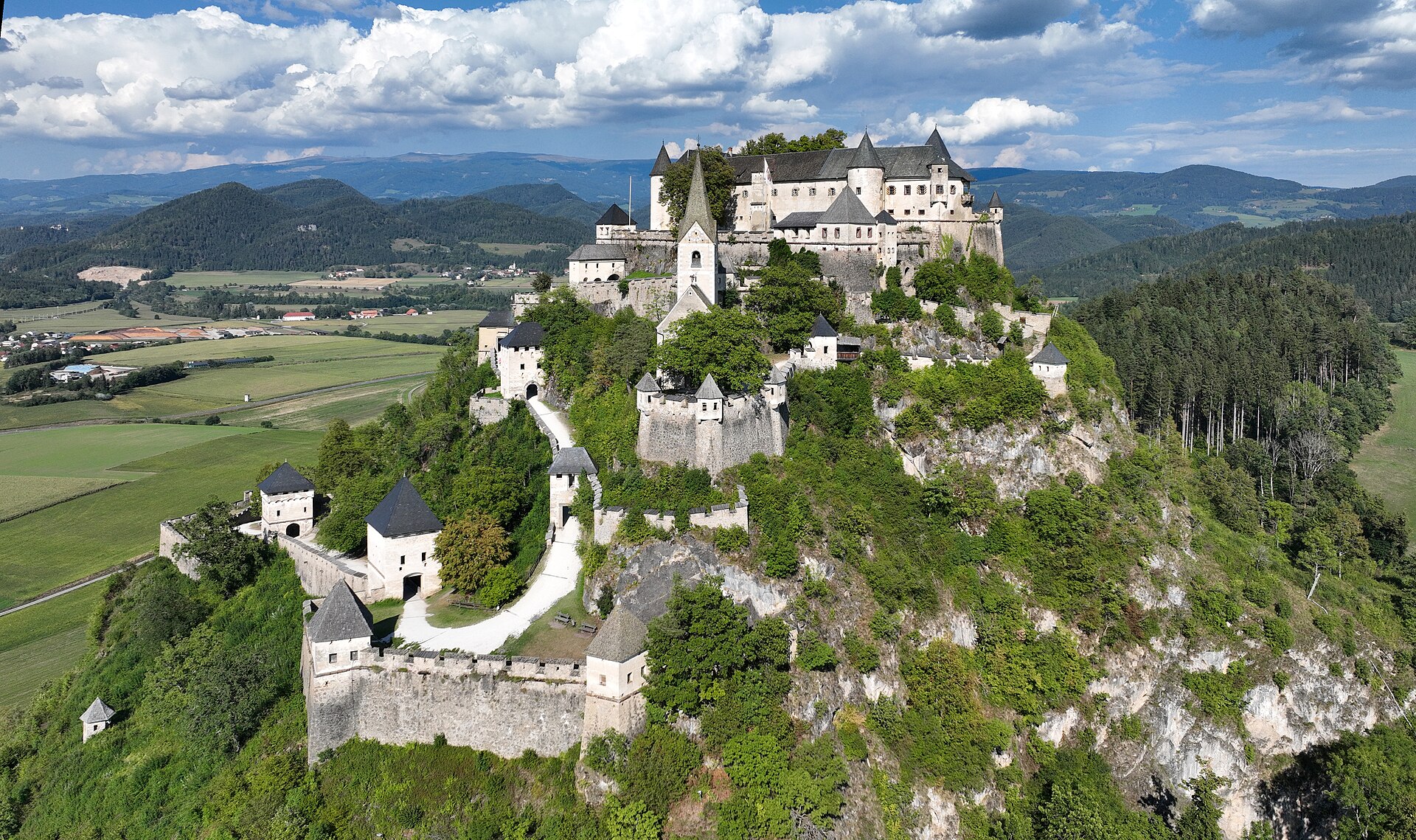
Burg Hochosterwitz is a medieval fortress situated on a 172-meter-high dolomite rock near Launsdorf in Carinthia, Austria. First mentioned in a document in 860 CE, the castle is renowned for its unique defensive system, which includes 14 fortified gates designed to thwart attackers during the Middle Ages. The current structure largely reflects the extensive fortifications added in the 16th century to protect against Ottoman incursions.
The castle remains in the possession of the Khevenhüller family, who have held the site since the 16th century. It serves as a significant example of defensive architecture, featuring a museum that houses a collection of historical armor, weapons, and family artifacts, while offering expansive views of the surrounding Carinthian landscape.
Key Facts
- Materials
- Dolomite rock, Stone masonry, Timber
- Civilization
- Austrian / Holy Roman Empire
- Accessibility
- Steep incline; funicular available for visitors
- Date(s)
- 860 CE (first mention); 1570-1586 (current fortifications)
- Condition
- Well-preserved, privately owned, open to the public
- Original Function
- Defensive fortress
- Key Figures
- Georg Khevenhüller
Early Origins
9th - 15th CenturyThe castle was first documented in 860 CE when King Louis the German donated the site to the Archdiocese of Salzburg. It served as a strategic stronghold throughout the Middle Ages, changing hands between various noble families and the Church.
Expansion and Fortification
16th CenturyIn 1571, Archduke Karl II of Inner Austria granted the castle to Georg Khevenhüller. Facing the threat of Ottoman invasions, Khevenhüller undertook a massive reconstruction project, completing the 14-gate defensive system between 1570 and 1586, which rendered the fortress virtually impregnable.
Modern Era
17th Century - PresentThe castle has remained in the possession of the Khevenhüller family for over 450 years. It survived the Napoleonic Wars and subsequent conflicts largely intact. Today, it functions as a museum and cultural landmark, maintaining its historical integrity through continuous private stewardship.
Cultural Significance
Burg Hochosterwitz is a symbol of Carinthian heritage and the historical struggle against Ottoman expansion in Central Europe. Its 14-gate system is considered a masterpiece of military engineering, representing the height of Renaissance-era defensive design in the region.
Beyond its military history, the castle is deeply linked to the identity of the Khevenhüller family, whose long-term preservation of the site has made it one of the most iconic landmarks in Austria. It remains a focal point for regional tourism and historical education regarding the feudal structures of the Holy Roman Empire.
Interpretive Notes
Scholarly debates and areas of uncertainty
There is ongoing discussion among architectural historians regarding the extent to which the 14-gate system was purely functional versus symbolic. While clearly designed for defense, some scholars argue the elaborate sequence of gates also served as a display of the Khevenhüller family's wealth and political status.
Visiting Information
Entry Rules
Open seasonally from April to October. Tickets are required for entry. Visitors can reach the castle via a steep walking path or a funicular railway. Pets are generally not permitted inside the museum areas.
Best Times to Visit
Late spring and early autumn offer the best weather for the steep ascent. Visiting on weekdays avoids the peak weekend crowds during the summer months.
Photography
Photography is permitted in the outdoor courtyards and exterior areas. Photography inside the museum and armory is strictly prohibited to protect the artifacts.
Preservation Notes
The site is a private monument; visitors must remain on marked paths. Due to the age of the structure, some areas may have uneven surfaces. Restoration work is ongoing to maintain the masonry of the 14 gates.
Nearby POIs
0 shownNo nearby POIs listed yet.
Sources & Further Reading
- [1]Die Khevenhüller auf Hochosterwitz — Georg Khevenhüller. Carinthian Historical Society (1995)
- [2]Burgen und Schlösser in Kärnten — Hugo Henckel von Donnersmarck. Verlag Carinthia (2002)
Key Facts
- Materials
- Dolomite rock, Stone masonry, Timber
- Civilization
- Austrian / Holy Roman Empire
- Accessibility
- Steep incline; funicular available for visitors
- Date(s)
- 860 CE (first mention); 1570-1586 (current fortifications)
- Condition
- Well-preserved, privately owned, open to the public
- Original Function
- Defensive fortress
- Key Figures
- Georg Khevenhüller
Nearby POIs
0 shownNo nearby POIs listed yet.