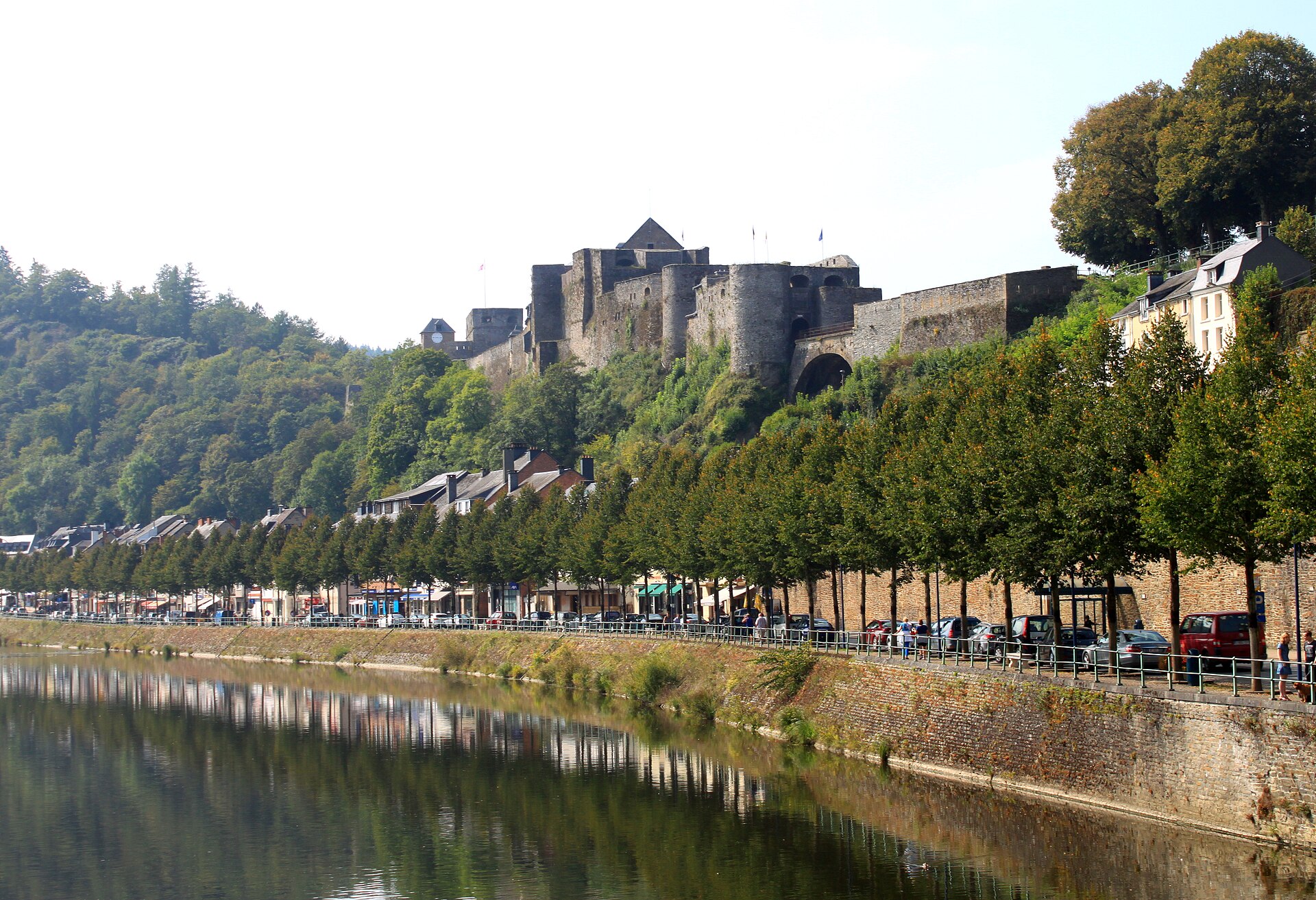
Bouillon Castle is a medieval fortification situated on a rocky promontory overlooking the Semois River in the Belgian Ardennes. Its strategic location made it a vital defensive stronghold throughout the Middle Ages, most notably serving as the ancestral seat of Godfrey of Bouillon, a leader of the First Crusade who famously sold the castle to the Prince-Bishopric of Liège to fund his expedition.
The structure features an intricate defensive system, including multiple drawbridges, fortified towers, and a series of deep, rock-cut tunnels and vaulted chambers. While the original medieval layout remains the core of the site, significant modifications were made in the 17th century under the direction of the French military engineer Vauban, who adapted the fortress to accommodate gunpowder artillery.
Key Facts
- Materials
- Schist, Sandstone, Mortar
- Civilization
- Medieval European
- Accessibility
- Steep terrain and uneven stone surfaces; limited accessibility in tunnel sections
- Date(s)
- 10th century - 17th century
- Condition
- Well-preserved, open as a museum and historical site
- Original Function
- Feudal stronghold and defensive fortification
- Key Figures
- Godfrey of Bouillon, Vauban
Early Origins
10th centuryThe first stone fortifications were established in the 10th century to control the valley of the Semois. It quickly became the seat of the Duchy of Bouillon.
The Crusader Era
11th centuryGodfrey of Bouillon, Duke of Lower Lorraine, inherited the castle. In 1096, he sold the fortress to the Prince-Bishop of Liège to finance his participation in the First Crusade.
Vauban's Modifications
17th centuryFollowing the conquest of the region by Louis XIV, the military engineer Vauban redesigned the castle's defenses to withstand modern artillery, adding bastions and reinforced walls.
Modern Preservation
20th century - presentThe castle was decommissioned as a military site and transitioned into a public heritage site, undergoing extensive restoration to preserve its medieval and early modern architectural features.
Cultural Significance
Bouillon Castle is a central symbol of Belgian medieval history and the legacy of the Crusades. It represents the transition from feudal castle architecture to the sophisticated defensive systems of the early modern period. The site is deeply linked to the identity of the town of Bouillon and remains a primary example of defensive military engineering in the Ardennes region.
Interpretive Notes
Scholarly debates and areas of uncertainty
The extent of the original 10th-century footprint remains a subject of archaeological investigation, as subsequent centuries of heavy fortification and Vauban's extensive remodeling have obscured much of the earliest masonry.
Visiting Information
Entry Rules
Open daily. Tickets are required for entry. Visitors are advised to wear sturdy footwear due to the uneven stone floors and steep inclines within the castle grounds.
Best Times to Visit
Spring and autumn offer the best weather for exploring the outdoor ramparts and the surrounding valley views. Summer months can be crowded with tourists.
Photography
Personal photography is permitted throughout the site. Commercial photography requires prior authorization from the castle administration.
Preservation Notes
The site contains fragile masonry and deep subterranean passages. Visitors must remain on marked paths and refrain from climbing on defensive walls or parapets.
Nearby POIs
0 shownNo nearby POIs listed yet.
Sources & Further Reading
- [1]The Castles of Belgium — Jean-Pierre Ducastelle. Heritage Press (2015)
- [2]Vauban and the Fortifications of the Ardennes — Marc F. Vandevelde. Military History Quarterly (2019)
Key Facts
- Materials
- Schist, Sandstone, Mortar
- Civilization
- Medieval European
- Accessibility
- Steep terrain and uneven stone surfaces; limited accessibility in tunnel sections
- Date(s)
- 10th century - 17th century
- Condition
- Well-preserved, open as a museum and historical site
- Original Function
- Feudal stronghold and defensive fortification
- Key Figures
- Godfrey of Bouillon, Vauban
Nearby POIs
0 shownNo nearby POIs listed yet.