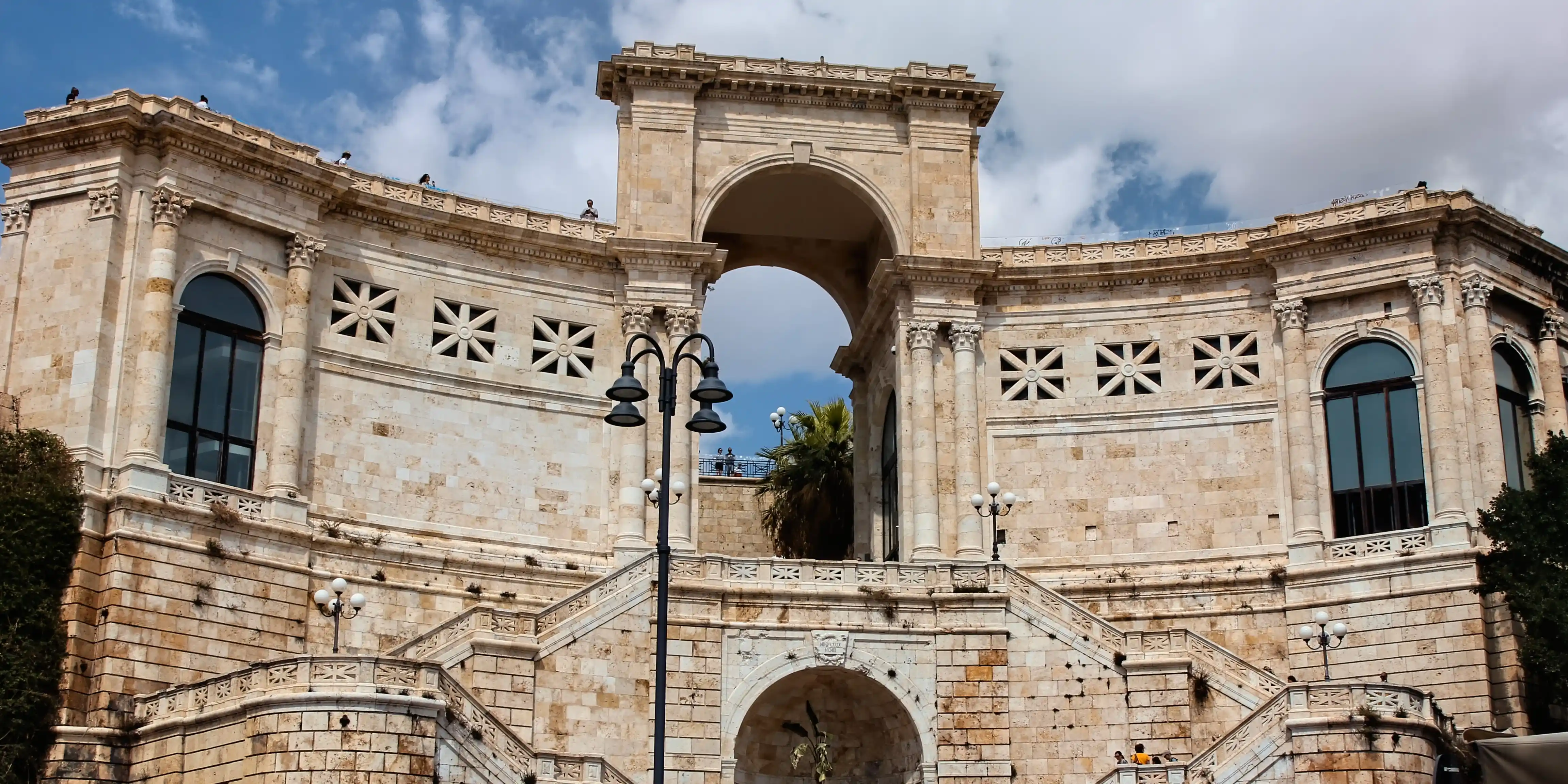
The Bastione di Saint Remy is a prominent architectural landmark in Cagliari, Sardinia, serving as a monumental connection between the historic Castello district and the lower city quarters. Constructed between 1896 and 1902, the structure was built atop the ancient medieval defensive walls that once protected the city, replacing older fortifications with a grand neoclassical design.
The site is defined by its expansive panoramic terrace, the Terrazza Umberto I, and a majestic double staircase leading to a triumphal arch. Built primarily of white limestone and yellow sandstone, the bastion serves as both a functional urban thoroughfare and a major public gathering space, offering extensive views of the Gulf of Cagliari and the surrounding urban landscape.
Key Facts
- Materials
- Limestone, Sandstone
- Civilization
- Italian
- Accessibility
- Accessible via elevator and stairs
- Date(s)
- 1896-1902
- Condition
- Well-preserved, active public space
- Original Function
- Defensive fortification and urban connection
- Key Figures
- Giuseppe Costa, Fulgenzio Setti
Medieval Origins
14th CenturyThe site originally formed part of the defensive system of the Castello district, established during the Pisan domination. These fortifications were later reinforced by the Spanish to protect the city from maritime attacks.
Neoclassical Transformation
1896-1902As the city expanded and defensive walls became obsolete, the municipal government commissioned the construction of a monumental structure to link the upper and lower city. Architects Giuseppe Costa and Fulgenzio Setti designed the current neoclassical facade.
Wartime Damage and Restoration
1943During the Allied bombing of Cagliari in World War II, the bastion suffered significant damage. Post-war restoration efforts successfully reconstructed the damaged sections, preserving the original neoclassical aesthetic.
Cultural Significance
The Bastione di Saint Remy is the symbolic heart of Cagliari, representing the city's transition from a fortified medieval stronghold to a modern urban center. It serves as the primary venue for public events, cultural exhibitions, and social life in the historic center.
Locally, the terrace is considered the city's 'living room,' where residents and visitors gather to observe the sunset over the Mediterranean. Its architectural prominence makes it the most recognizable silhouette of the Cagliari skyline.
Interpretive Notes
Scholarly debates and areas of uncertainty
There is ongoing academic discussion regarding the balance between preserving the medieval structural integrity of the underlying walls versus the aesthetic prominence of the 19th-century neoclassical facade, particularly during modern maintenance projects.
Visiting Information
Entry Rules
Open to the public 24 hours a day. No entry fee required. The site is a public thoroughfare.
Best Times to Visit
Sunset for panoramic views and evening social atmosphere. Early morning for photography without crowds.
Photography
Personal photography is permitted. Commercial photography requires municipal authorization.
Preservation Notes
The structure is subject to ongoing maintenance due to its exposure to coastal winds and salt air. Visitors are requested to respect the historic stonework and refrain from climbing on non-designated areas.
Nearby POIs
0 shownNo nearby POIs listed yet.
Sources & Further Reading
- [1]Cagliari: Monumenti e Storia — Francesco Cesare Casula. Delfino Editore (2010)
- [2]Architettura in Sardegna — Salvatore Naitza. Ilisso Edizioni (1992)
Key Facts
- Materials
- Limestone, Sandstone
- Civilization
- Italian
- Accessibility
- Accessible via elevator and stairs
- Date(s)
- 1896-1902
- Condition
- Well-preserved, active public space
- Original Function
- Defensive fortification and urban connection
- Key Figures
- Giuseppe Costa, Fulgenzio Setti
Nearby POIs
0 shownNo nearby POIs listed yet.