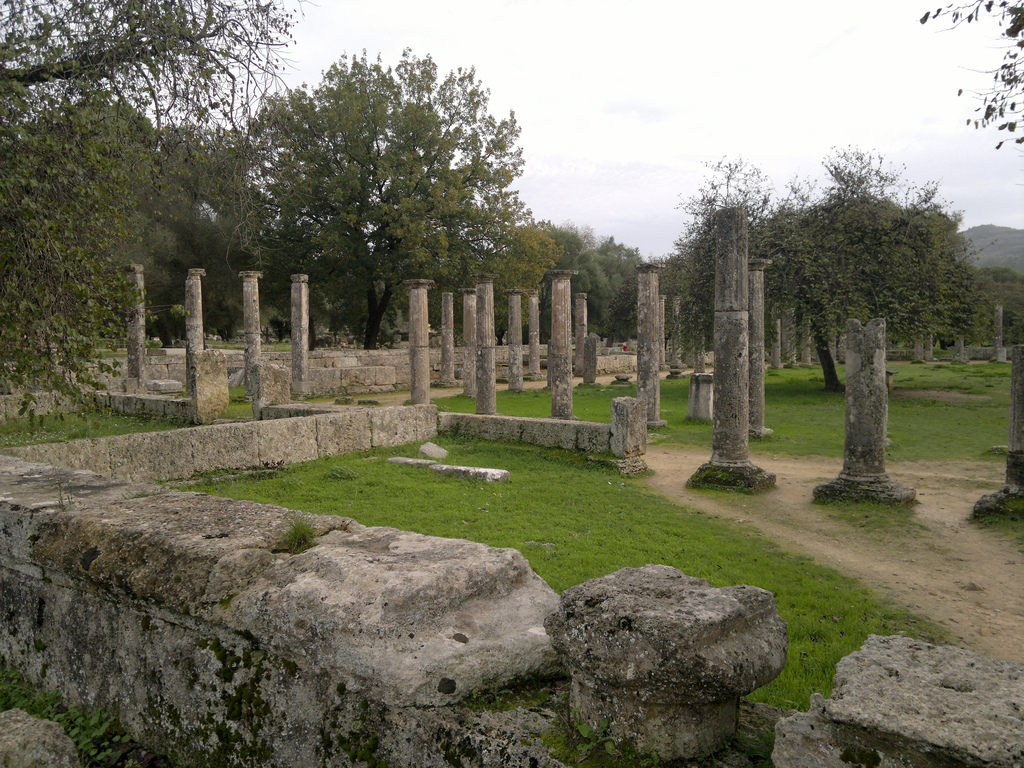
Olympia was a major Panhellenic religious sanctuary in ancient Greece, situated in the western Peloponnese. It served as the site of the ancient Olympic Games, which were held every four years in honor of Zeus starting in 776 BCE. The sanctuary was not a city, but a sacred precinct containing temples, treasuries, and athletic facilities.
The site is dominated by the Altis, a sacred grove containing the Temple of Zeus, which once housed one of the Seven Wonders of the Ancient World: the chryselephantine statue of Zeus by Phidias. Following the abolition of the games by Emperor Theodosius I in 393 CE and subsequent natural disasters, the site fell into disuse and was buried by river silt until its rediscovery in the 18th century.
Key Facts
- Materials
- Limestone, Pentelic marble, Terracotta
- Civilization
- Ancient Greek
- Accessibility
- Partially accessible; some gravel paths
- Date(s)
- 10th century BCE - 4th century CE
- Condition
- Archaeological site with partially reconstructed structures
- Original Function
- Religious sanctuary and athletic venue
- Key Figures
- Phidias, Pausanias, Theodosius I
Early Origins
10th - 8th century BCEThe site began as a local cult center dedicated to chthonic deities before the worship of Zeus became dominant. The first recorded Olympic Games were held in 776 BCE, marking the beginning of the site's pan-Hellenic importance.
The Classical Zenith
5th century BCEThis period saw the construction of the massive Temple of Zeus and the development of the stadium. The sanctuary became the political and religious heart of the Greek world, attracting pilgrims and athletes from across the Mediterranean.
Roman Expansion
1st century BCE - 3rd century CEUnder Roman rule, the site underwent significant renovations. Nero famously participated in the games, and new structures like the Nymphaeum were added to improve the site's infrastructure.
Decline and Rediscovery
4th century CE - 1875The games were banned in 393 CE as part of the Christianization of the Roman Empire. Earthquakes and floods eventually buried the site, which remained largely forgotten until excavations began in the late 19th century.
Cultural Significance
Olympia represents the birthplace of the Olympic Games, a symbol of athletic excellence and the 'Olympic Truce' which temporarily halted conflicts between Greek city-states. It remains a powerful symbol of international cooperation and peace, with the modern Olympic flame still ignited at the site today.
Beyond athletics, the site is a cornerstone of Western art history, having housed the workshop of Phidias. The archaeological remains provide critical evidence for the development of Greek architecture and the evolution of religious practices in the ancient world.
Interpretive Notes
Scholarly debates and areas of uncertainty
The exact origins of the Olympic Games remain a subject of debate, with some scholars arguing for a funerary origin linked to the myth of Pelops, while others emphasize the site's role as a pre-existing religious center. Additionally, the extent of the damage caused by the Herulian invasion in 267 CE versus natural seismic activity is frequently discussed by archaeologists.
Visiting Information
Entry Rules
Open daily. Tickets are required for entry to the archaeological site and the museum. Visitors should wear comfortable walking shoes and sun protection, as the site is largely exposed.
Best Times to Visit
Early morning or late afternoon to avoid peak heat and tour bus crowds. Spring and autumn offer the most temperate weather for exploring the expansive grounds.
Photography
Personal photography is permitted. Tripods and professional equipment require prior authorization from the Hellenic Ministry of Culture.
Preservation Notes
Do not climb on ruins or move stones. Stay on designated paths to protect the fragile archaeological strata. The site is subject to ongoing conservation efforts.
Nearby POIs
0 shownNo nearby POIs listed yet.
Sources & Further Reading
- [1]Olympia: The Archaeology of the Ancient Games — Judith Swaddling. British Museum Press (2008)
- [2]The Archaeology of Greece: An Introduction — William R. Biers. Cornell University Press (1996)
Key Facts
- Materials
- Limestone, Pentelic marble, Terracotta
- Civilization
- Ancient Greek
- Accessibility
- Partially accessible; some gravel paths
- Date(s)
- 10th century BCE - 4th century CE
- Condition
- Archaeological site with partially reconstructed structures
- Original Function
- Religious sanctuary and athletic venue
- Key Figures
- Phidias, Pausanias, Theodosius I
Nearby POIs
0 shownNo nearby POIs listed yet.