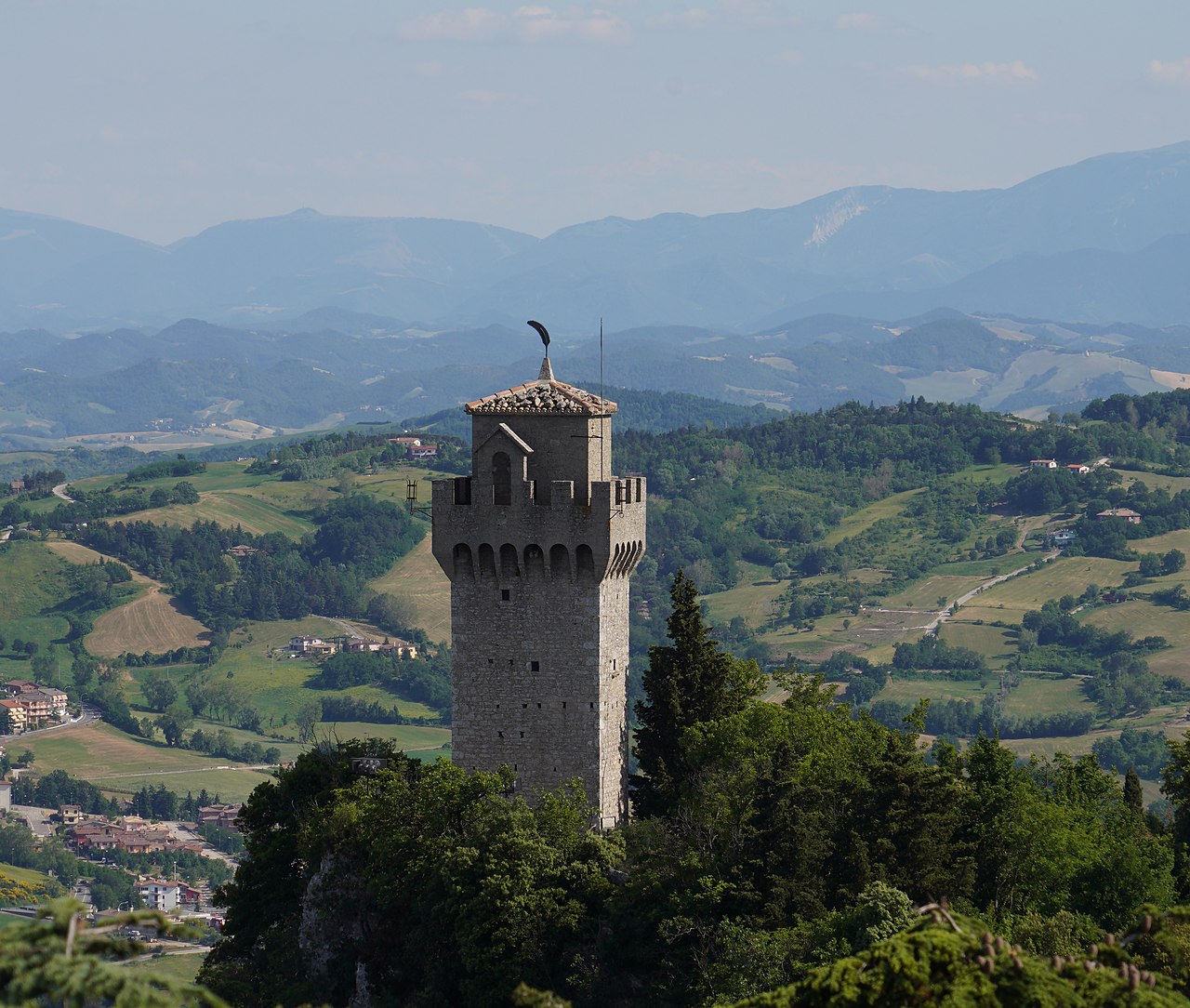
The Torre del Montale is the third and smallest of the three towers that crown the summit of Monte Titano in the Republic of San Marino. Constructed in the 14th century, it served as a critical strategic lookout post, providing an expansive view of the surrounding territory and the Adriatic coast to detect approaching threats.
Unlike the other two towers, the Montale features a unique pentagonal floor plan and includes a deep pit prison, known as the 'bottom of the tower,' which was accessible only through an overhead hatch. While it was once a vital component of the defensive fortification system of San Marino, it is currently closed to the public, though it remains a prominent landmark visible from the nearby walking paths.
Key Facts
- Materials
- Local stone
- Civilization
- Sammarinese
- Accessibility
- Exterior visible via hiking trails; interior inaccessible
- Date(s)
- 14th century
- Condition
- Well-preserved exterior, closed to public entry
- Original Function
- Strategic lookout and prison
- Key Figures
Strategic Origins
14th centuryThe tower was built around 1320 to bolster the defensive capabilities of the Republic of San Marino. Its location on the highest peak of Monte Titano made it an essential watchtower for monitoring the Malatesta family's movements in the valley below.
Military Function
14th-16th centuryDuring the period of frequent conflicts between the Malatesta and the Republic, the Montale served as a primary warning station. Its design included a deep pit prison, which was used to hold captives, reflecting the harsh realities of medieval border warfare.
Modern Preservation
20th century - presentFollowing the decline of its military utility, the tower underwent various restoration efforts to maintain its structural integrity. It is now protected as part of the UNESCO World Heritage site encompassing the historic center of San Marino and Mount Titano.
Cultural Significance
The Torre del Montale is a symbol of San Marino's long-standing independence and defensive ingenuity. Together with the Guaita and Cesta towers, it represents the 'Three Towers' that appear on the national flag and coat of arms, serving as a powerful emblem of the republic's resilience and sovereignty.
Interpretive Notes
Scholarly debates and areas of uncertainty
There is minor academic discussion regarding the exact architectural evolution of the tower, specifically whether the pentagonal structure was an original design choice or a later modification to improve defensive angles against early gunpowder artillery.
Visiting Information
Entry Rules
The tower is currently closed to the public. The exterior can be viewed from the surrounding public hiking trails.
Best Times to Visit
Spring and autumn for clear visibility of the Adriatic coast and comfortable hiking conditions on the mountain paths.
Photography
Exterior photography is permitted from public trails.
Preservation Notes
The site is a protected monument. Visitors must remain on marked trails and are prohibited from attempting to access the interior of the structure.
Nearby POIs
7 shownSources & Further Reading
- [1]
- [2]The History of San Marino — William Miller. American Historical Review (1901)
Key Facts
- Materials
- Local stone
- Civilization
- Sammarinese
- Accessibility
- Exterior visible via hiking trails; interior inaccessible
- Date(s)
- 14th century
- Condition
- Well-preserved exterior, closed to public entry
- Original Function
- Strategic lookout and prison
- Key Figures