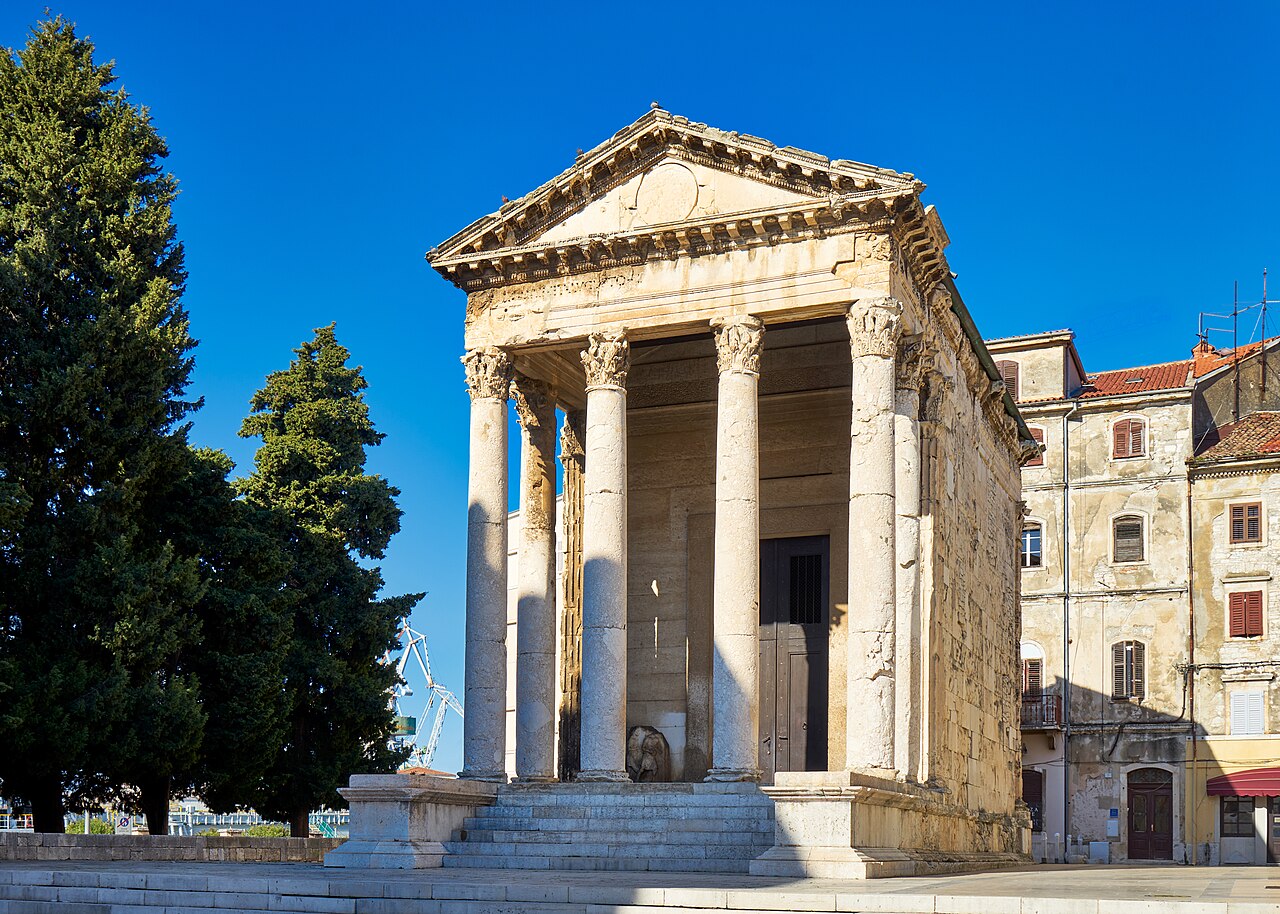
The Temple of Augustus is a well-preserved Roman temple located in the city of Pula, Croatia. Constructed during the early Roman Empire, it was dedicated to the first emperor, Augustus, and the goddess Roma. The structure stands on the site of the former Roman forum and serves as a significant example of Augustan-era architecture in the Adriatic region.
The temple features a tetrastyle portico with six Corinthian columns supporting a detailed frieze and pediment. Following the decline of the Roman Empire, the building was repurposed as a Christian church, later serving as a granary and a museum. Today, it houses a collection of Roman stone and bronze sculptures, continuing to function as a focal point for the city's historical center.
Key Facts
- Materials
- Stone, Marble
- Civilization
- Roman
- Accessibility
- Ground level access, limited interior space
- Date(s)
- 2 BCE - 14 CE
- Condition
- Well-preserved, serves as a lapidarium museum
- Original Function
- Temple dedicated to Augustus and Roma
- Key Figures
- Augustus
Construction
2 BCE - 14 CEThe temple was built during the reign of Augustus, likely between 2 BCE and his death in 14 CE. It was part of a triad of temples in the Pula forum, positioned alongside a larger central temple and a twin structure.
Christian Conversion
6th century CEFollowing the rise of Christianity, the temple was converted into a church. This repurposing facilitated the structural preservation of the building throughout the Middle Ages, preventing the total collapse seen in other forum structures.
Modern Restoration
1944 - 1947The temple suffered significant damage during Allied bombing raids in 1944. Between 1945 and 1947, the structure underwent extensive reconstruction to restore its original appearance, allowing it to house the city's archaeological collection.
Cultural Significance
The Temple of Augustus is a symbol of Pula's Roman heritage and its integration into the imperial cult. It represents the reach of Roman administrative and religious influence in the province of Histria. Locally, it remains the most iconic landmark of the city, anchoring the historic forum square.
Interpretive Notes
Scholarly debates and areas of uncertainty
There is minor scholarly discussion regarding the exact date of construction, as the dedicatory inscription on the architrave is stylistically consistent with the early Augustan period, though some debate exists regarding whether it was completed before or after the emperor's death.
Visiting Information
Entry Rules
Open to the public as a museum. Entry requires a standard admission ticket. Visitors are expected to maintain decorum as the site contains historical artifacts.
Best Times to Visit
Early morning or late afternoon to avoid peak summer heat and cruise ship crowds in the forum area.
Photography
Personal photography is permitted. Flash and tripods are generally prohibited inside the museum area.
Preservation Notes
The structure is fragile; visitors should avoid touching the ancient stone surfaces and remain within designated viewing areas.
Nearby POIs
5 shownSources & Further Reading
- [1]The Temple of Augustus in Pula — Štefan Mlakar. Archaeological Museum of Istria (1965)
- [2]Roman Architecture in the Adriatic — John Wilkes. Oxford University Press (1992)
Key Facts
- Materials
- Stone, Marble
- Civilization
- Roman
- Accessibility
- Ground level access, limited interior space
- Date(s)
- 2 BCE - 14 CE
- Condition
- Well-preserved, serves as a lapidarium museum
- Original Function
- Temple dedicated to Augustus and Roma
- Key Figures
- Augustus