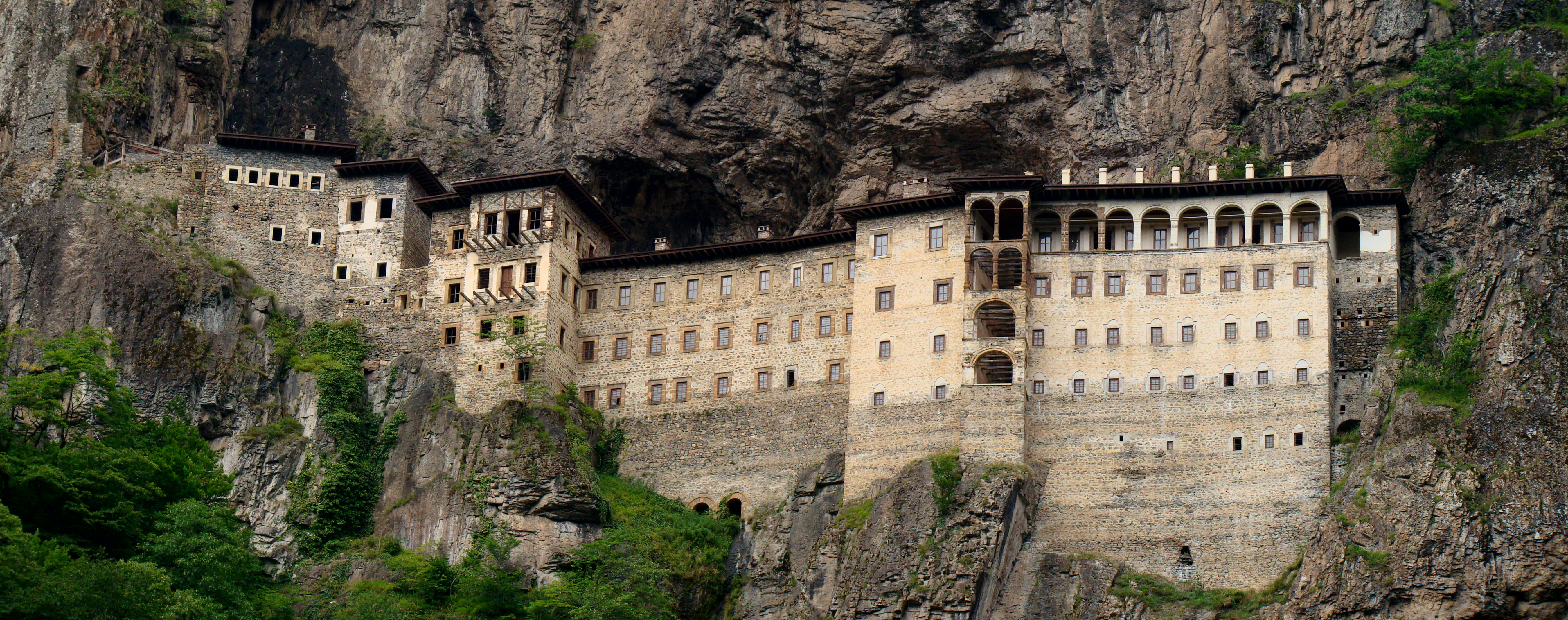
Sumela Monastery is a Greek Orthodox monastic complex dedicated to the Virgin Mary, situated at an altitude of 1,200 meters on the steep cliffs of the Altındere Valley in the Trabzon Province of Turkey. Founded in the 4th century, the site is renowned for its dramatic architectural integration into the sheer rock face and its extensive collection of frescoes.
The complex consists of several chapels, kitchens, student rooms, a library, and a sacred spring. While the monastery underwent significant expansion and renovation during the 18th and 19th centuries, it remains a testament to the long-standing Christian presence in the Pontic region and serves as a significant site for both religious pilgrimage and historical tourism.
Key Facts
- Materials
- Stone, Rock-cut masonry, Wood
- Civilization
- Byzantine
- Accessibility
- Accessible via shuttle and steep walking path
- Date(s)
- 386 CE
- Condition
- Restored and open as a museum
- Original Function
- Monastery
- Key Figures
- Barnabas, Sophronius
Founding and Early History
4th centuryAccording to tradition, the monastery was founded in 386 CE by the monks Barnabas and Sophronius, who discovered a miraculous icon of the Virgin Mary in a cave on the mountain. It became a prominent center for monastic life in the Byzantine Empire.
Imperial Patronage
13th-15th centuryDuring the era of the Empire of Trebizond, the monastery received significant support from the Komnenos dynasty. It was during this period that the complex gained much of its architectural prestige and religious importance in the region.
Ottoman Era
15th-19th centuryFollowing the Ottoman conquest of Trabzon in 1461, the monastery was granted protection by successive Sultans. It continued to function as a major pilgrimage site, with many of the current frescoes and structural additions dating to the 18th and 19th centuries.
Abandonment and Restoration
20th century - presentThe monastery was abandoned in 1923 following the population exchange between Greece and Turkey. After decades of neglect, the site underwent extensive restoration by the Turkish Ministry of Culture and Tourism, reopening to the public as a museum.
Cultural Significance
Sumela Monastery represents the intersection of Byzantine religious tradition and the rugged geography of the Pontic Mountains. It serves as a vital symbol of the historical cultural diversity of the Black Sea region.
For the Pontic Greek community, the monastery remains a site of profound spiritual and ancestral connection. Its preservation is a focal point for cultural heritage dialogue between Turkey and Greece, highlighting the shared history of the region's religious architecture.
Interpretive Notes
Scholarly debates and areas of uncertainty
There is ongoing academic discussion regarding the exact dating of the earliest rock-cut structures versus the later masonry additions. Additionally, the extent of the original 4th-century iconographic program remains a subject of investigation due to the heavy overpainting that occurred during the 18th-century renovations.
Visiting Information
Entry Rules
Open daily, subject to seasonal weather conditions. Tickets are required for entry. Visitors must adhere to designated paths and respect the site's status as a protected cultural monument.
Best Times to Visit
Late spring and early autumn offer the best weather for the steep climb. Early morning visits are recommended to avoid heavy tourist crowds and afternoon fog.
Photography
Personal photography is permitted in most areas. Flash photography is strictly prohibited inside the chapels to protect the fragile frescoes.
Nearby POIs
0 shownNo nearby POIs listed yet.
Sources & Further Reading
- [1]
- [2]Byzantine Monuments of the Pontos — David Winfield. Ashgate Publishing (1985)
Key Facts
- Materials
- Stone, Rock-cut masonry, Wood
- Civilization
- Byzantine
- Accessibility
- Accessible via shuttle and steep walking path