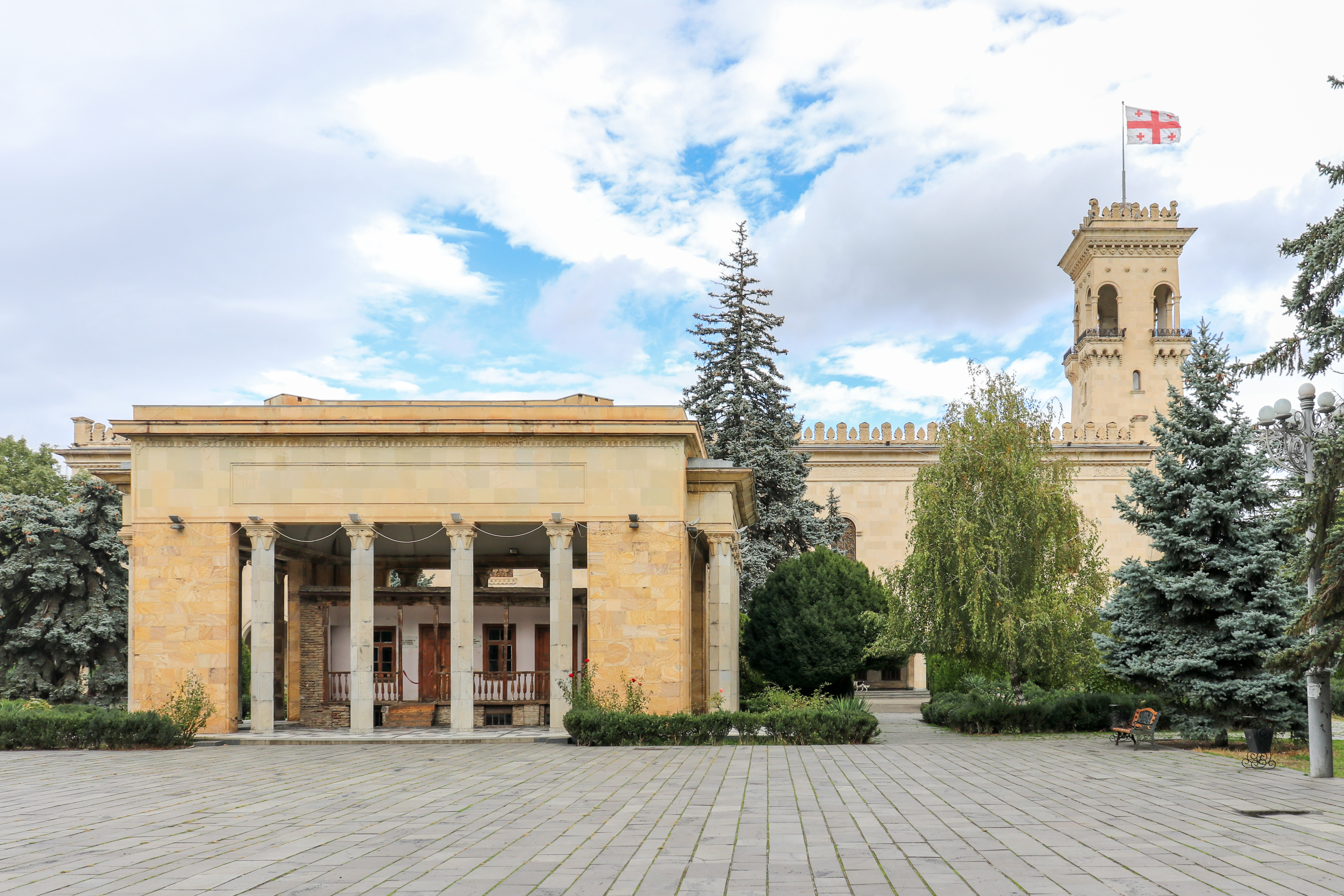
The Joseph Stalin Museum is located in Gori, Georgia, the birthplace of the Soviet leader. Established in 1957, the museum complex is dedicated to documenting the life and political career of Joseph Stalin through an extensive collection of personal artifacts, photographs, and state documents.
The museum grounds include the original small wooden house where Stalin was born, which is protected by a Greco-Italianate canopy, and his personal armored railway carriage used for travel to the Tehran, Yalta, and Potsdam conferences. The main exhibition hall features a collection of gifts presented to Stalin by various world leaders and socialist organizations, alongside propaganda art and historical displays.
Key Facts
- Materials
- Stone, Marble, Wood
- Civilization
- Soviet
- Accessibility
- Ground floor accessible
- Date(s)
- 1957
- Condition
- Active
- Original Function
- Museum
- Key Figures
- Joseph Stalin
Establishment
1957The museum was opened during the post-Stalin era, shortly after the 20th Party Congress and the beginning of de-Stalinization, yet it maintained a focus on his role as a revolutionary and wartime leader.
Post-Soviet Transition
1991-2008Following the collapse of the Soviet Union and Georgia's independence, the museum faced closure and political scrutiny. It was briefly closed in 1989 but reopened, continuing to serve as a site for historical documentation.
Modern Status
2010-presentThe museum remains a significant tourist destination in Gori. While there have been various proposals to rebrand the site as a 'Museum of Stalinism' to provide a more critical perspective on his regime, the current exhibition largely retains its original Soviet-era narrative structure.
Cultural Significance
The museum serves as a polarizing site of memory, reflecting the complex and often contradictory legacy of Joseph Stalin in his hometown. For some, it is a place of historical curiosity regarding the Soviet period, while for others, it remains a controversial site that critics argue fails to adequately address the human cost of Stalin's policies, such as the Great Purge and the Gulag system.
Interpretive Notes
Scholarly debates and areas of uncertainty
Debate persists regarding the museum's curatorial approach. Scholars and human rights organizations have criticized the institution for its lack of critical context regarding the atrocities committed under Stalin's rule, arguing that the museum functions more as a hagiography than an objective historical archive.
Visiting Information
Entry Rules
Open daily. Tickets are required for entry to the main museum building and the private railway carriage. Guided tours are available in multiple languages.
Best Times to Visit
Weekdays during the morning hours to avoid larger tour groups. The museum is less crowded during the winter months.
Photography
Personal photography is permitted throughout the museum. Flash photography is generally discouraged near sensitive archival documents.
Preservation Notes
The museum buildings and the railway carriage are subject to ongoing maintenance. Visitors are requested to refrain from touching the artifacts and to follow designated pathways.
Nearby POIs
3 shownSources & Further Reading
- [1]
- [2]The Stalin Museum in Gori: A Case Study in Memory — Julie A. Cassiday. Journal of Soviet and Post-Soviet Politics and Society (2015)
Key Facts
- Materials
- Stone, Marble, Wood
- Civilization
- Soviet
- Accessibility
- Ground floor accessible
- Date(s)
- 1957
- Condition
- Active
- Original Function
- Museum
- Key Figures
- Joseph Stalin