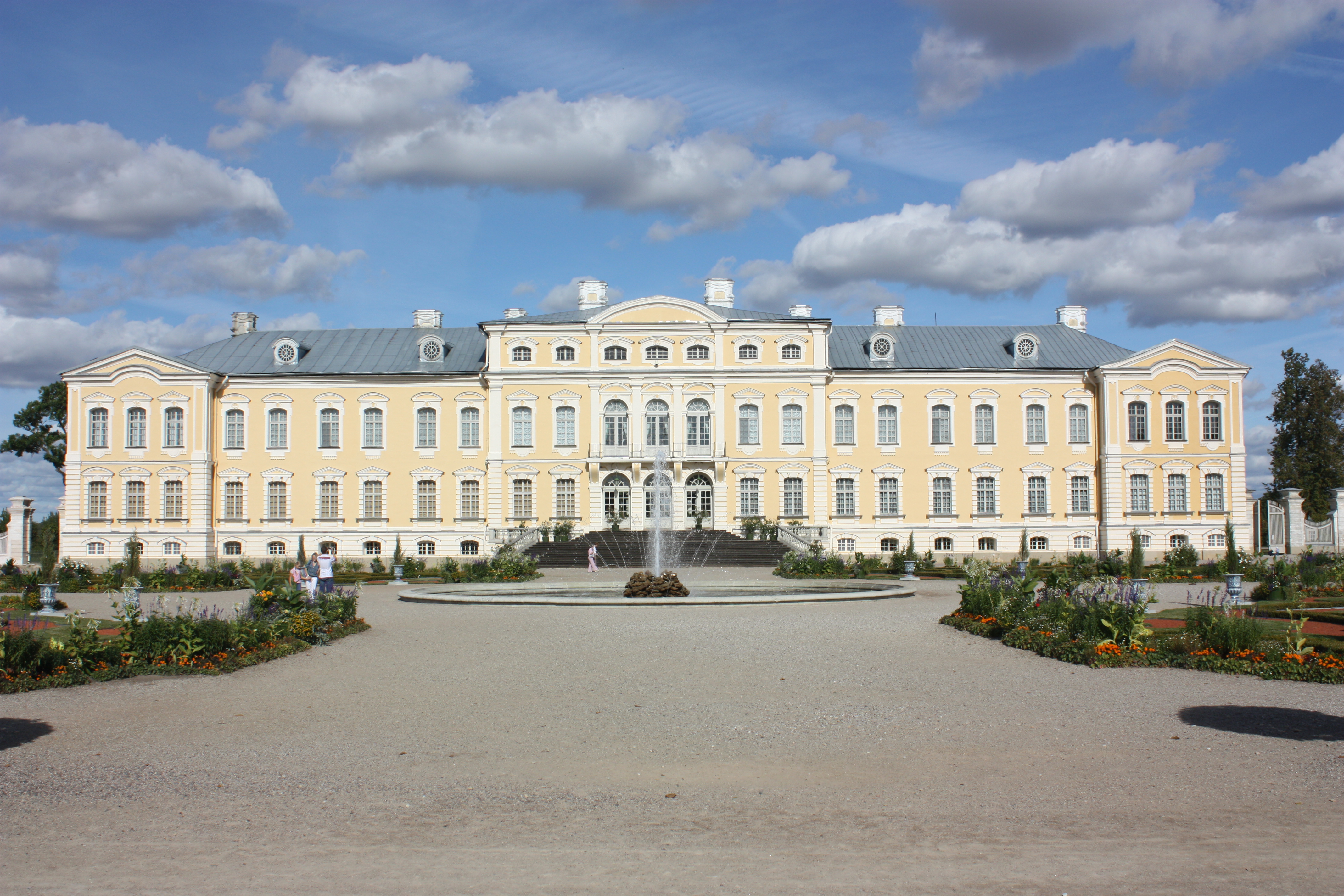
Rundāle Palace is a prominent Baroque and Rococo architectural monument located in the Zemgale region of Latvia. Designed by the Italian-Russian architect Bartolomeo Rastrelli, the palace served as the summer residence for Ernst Johann von Biron, the Duke of Courland and Semigallia. Construction began in 1736 and was completed in two main phases, reflecting the opulent tastes of the 18th-century Baltic nobility.
The palace complex is renowned for its highly decorative interiors, including the Golden Hall, the White Hall, and the Great Gallery, which feature intricate stucco work and ceiling paintings by artists Francesco Martini and Carlo Zucchi. The surrounding French-style formal gardens, also designed by Rastrelli, extend over 10 hectares and remain one of the most significant examples of landscape architecture in the Baltic states.
Key Facts
- Materials
- Brick, Stucco, Marble, Oak
- Civilization
- Duchy of Courland and Semigallia
- Accessibility
- Ground floor accessible; upper floors limited
- Date(s)
- 1736-1740; 1764-1768
- Condition
- Restored and operating as a museum
- Original Function
- Summer residence of the Duke of Courland
- Key Figures
- Bartolomeo Rastrelli, Ernst Johann von Biron
Initial Construction
1736-1740The foundation stone was laid in 1736 based on designs by Bartolomeo Rastrelli. Work was halted in 1740 following the fall of Duke Ernst Johann von Biron from power in the Russian Empire, leaving the structure unfinished for over two decades.
Completion and Decoration
1764-1768Upon the Duke's return to power, construction resumed. The interior finishing, including the elaborate stucco and fresco work, was completed during this period by a team of Italian artists brought to Courland specifically for the project.
Post-Ducal Era
1795-1918Following the annexation of the Duchy of Courland by the Russian Empire, the palace passed through several aristocratic families, most notably the Shuvalovs, who maintained the estate until the early 20th century.
Restoration and Museum
1972-presentAfter suffering damage during the World Wars and periods of neglect, a comprehensive restoration project began in 1972. Today, the palace functions as a museum, housing extensive collections of decorative arts and historical exhibitions.
Cultural Significance
Rundāle Palace is considered the most significant Baroque monument in Latvia and a symbol of the cultural exchange between Western Europe and the Baltic region during the 18th century. It serves as a primary repository for the history of the Duchy of Courland.
Beyond its architectural value, the palace acts as a center for historical research and restoration expertise in the Baltic region. Its annual festivals and garden events are central to the regional cultural calendar, drawing visitors from across Europe to experience 18th-century court life.
Interpretive Notes
Scholarly debates and areas of uncertainty
There is ongoing academic discussion regarding the extent of Rastrelli's personal involvement in the second phase of construction versus the influence of his assistants. Additionally, the authenticity of certain interior decorative elements, which were heavily reconstructed during the Soviet-era restoration, remains a subject of study among architectural historians.
Visiting Information
Entry Rules
Open daily. Tickets are required for entry to the palace interiors and the formal gardens. Visitors are requested to wear protective shoe covers provided at the entrance to preserve the historic parquet floors.
Best Times to Visit
Late spring and summer (May-August) are ideal for viewing the formal gardens in full bloom. Weekdays offer significantly lower visitor density compared to weekends.
Photography
Personal photography is permitted in the palace and gardens without flash or tripods. Professional or commercial photography requires prior authorization from the museum administration.
Preservation Notes
Do not touch the wall decorations or furniture. Stay within the roped-off areas in the state rooms. Smoking and food are prohibited inside the palace building.
Nearby POIs
1 shownSources & Further Reading
- [1]Rundāle Palace: The Baroque and Rococo Architecture — Imants Lancmanis. Rundāle Palace Museum Press (2015)
- [2]Bartolomeo Rastrelli and the Architecture of the Baltic — Dmitry Shvidkovsky. Yale University Press (2007)
Key Facts
- Materials
- Brick, Stucco, Marble, Oak
- Civilization
- Duchy of Courland and Semigallia
- Accessibility
- Ground floor accessible; upper floors limited
- Date(s)
- 1736-1740; 1764-1768
- Condition
- Restored and operating as a museum
- Original Function
- Summer residence of the Duke of Courland
- Key Figures
- Bartolomeo Rastrelli, Ernst Johann von Biron