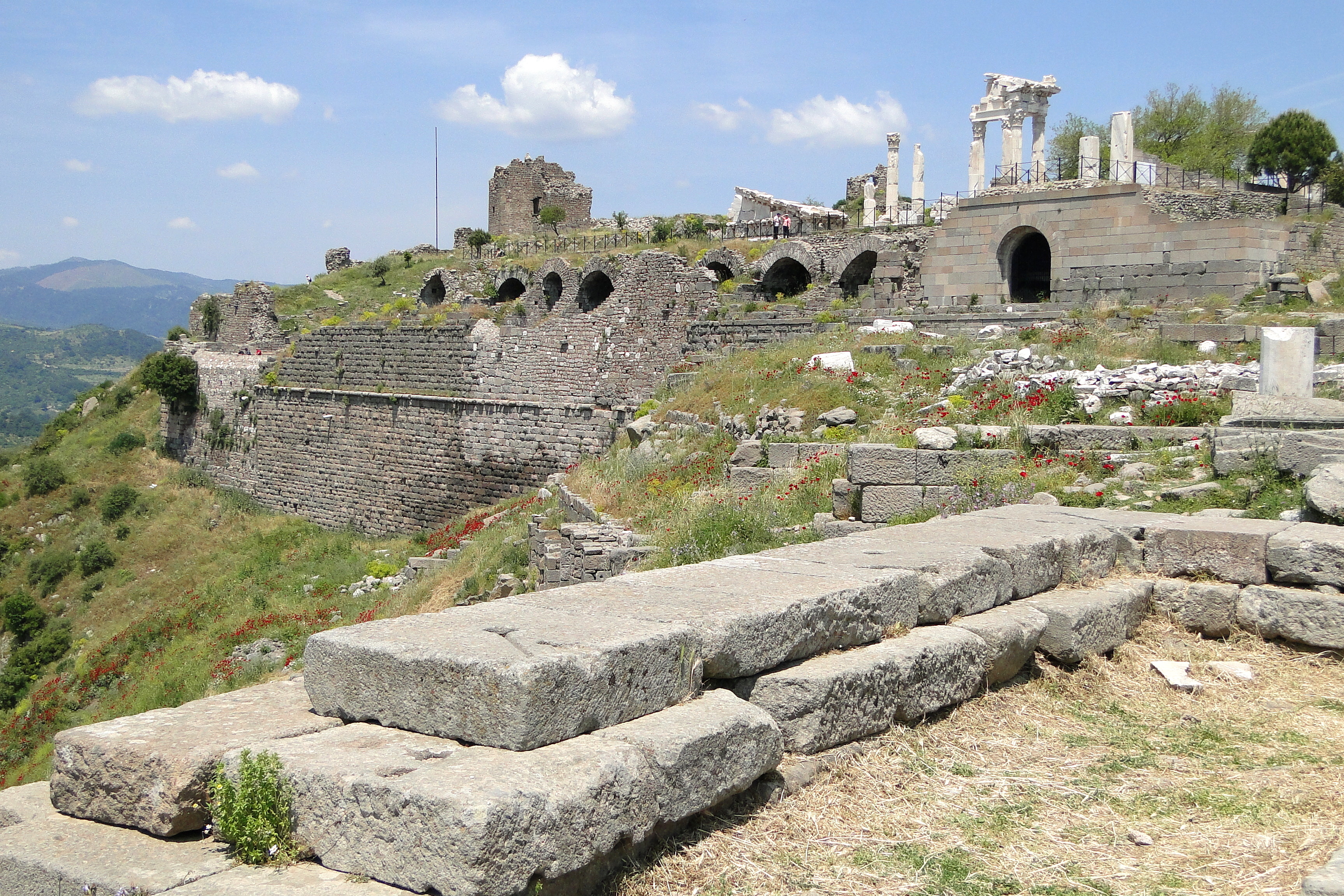
Pergamon was a powerful and influential ancient Greek city-state located in Aeolis, situated on a prominent hill overlooking the modern city of Bergama. During the Hellenistic period, it served as the capital of the Attalid dynasty, transforming into a major center of learning, art, and science. The city is renowned for its dramatic architectural planning, which utilized the steep terrain to create a series of terraced sanctuaries and public spaces.
The site is most famous for its monumental Acropolis, which housed the Altar of Zeus, the Temple of Athena, and the Library of Pergamon—the second-largest library in the ancient world after Alexandria. Following the Roman annexation in 133 BCE, the city continued to flourish as a significant provincial capital, eventually becoming a major center for early Christianity and later, Byzantine administration.
Key Facts
- Materials
- Andesite, Marble, Brick
- Civilization
- Hellenistic Greek, Roman
- Accessibility
- Steep terrain; cable car available to the Acropolis
- Date(s)
- 3rd century BCE - 4th century CE
- Condition
- Extensive archaeological ruins with significant structural remains
- Original Function
- Capital city, religious and cultural center
- Key Figures
- Eumenes II, Attalus I, Galen of Pergamon
Rise of the Attalids
281–133 BCEFollowing the death of Lysimachus, Philetaerus established the Attalid dynasty. Under Eumenes II, the city reached its zenith, with the construction of the Great Altar and the expansion of the library, which famously competed with the Library of Alexandria.
Roman Integration
133 BCE – 395 CEAttalus III bequeathed the kingdom to the Roman Republic. Pergamon thrived under Roman rule, becoming a center for medicine and the site of the Asclepeion, a renowned healing sanctuary visited by figures such as the physician Galen.
Byzantine and Ottoman Eras
4th – 19th centuryThe city declined in importance as the center of power shifted to Constantinople. It became a bishopric during the Byzantine period. Following the Ottoman conquest, the site was largely abandoned in favor of the settlement in the valley below, leading to the preservation of the upper ruins.
Archaeological Rediscovery
1878 – PresentSystematic excavations began in the late 19th century, led by German archaeologists such as Carl Humann. These efforts uncovered the Altar of Zeus and other major structures, many of which were transported to the Pergamon Museum in Berlin.