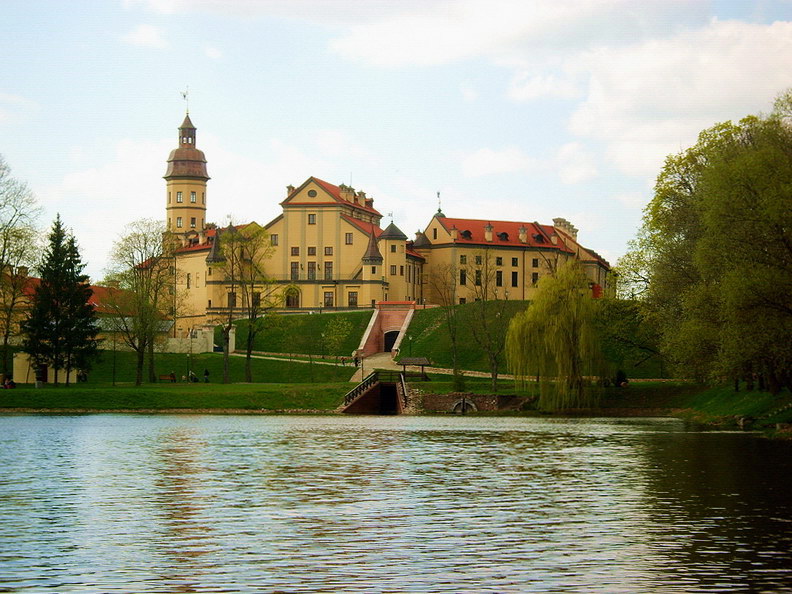
Nesvizh Castle is a residential castle complex located in Nesvizh, Belarus, which served as the primary seat of the Radziwiłł noble family from the 16th century until 1939. The site represents a significant example of the evolution of European architectural styles, blending Renaissance, Baroque, and Rococo elements within a fortified structure surrounded by an extensive park system.
The complex includes the main palace, a series of connected buildings, and the nearby Corpus Christi Church, which houses the crypt of the Radziwiłł family. Following extensive restoration work in the early 21st century, the castle now functions as a national historical and cultural museum, preserving the legacy of one of the most influential families in the Grand Duchy of Lithuania and the Polish-Lithuanian Commonwealth.
Key Facts
- Materials
- Brick, Stone, Plaster
- Civilization
- Grand Duchy of Lithuania
- Accessibility
- Ground floor accessible; upper levels limited
- Date(s)
- 1583 - 17th century
- Condition
- Fully restored and active as a museum
- Original Function
- Residential fortress and administrative center
- Key Figures
- Mikołaj Krzysztof 'the Orphan' Radziwiłł, Giovanni Maria Bernardoni
Foundation and Early Construction
1583Construction began under the patronage of Mikołaj Krzysztof 'the Orphan' Radziwiłł. The architect Giovanni Maria Bernardoni was commissioned to design the fortress, which replaced an earlier wooden structure and incorporated modern Italian fortification techniques.
Expansion and Baroque Transformation
17th - 18th centuryThroughout the 17th and 18th centuries, the castle underwent several expansions. The interiors were heavily modified to reflect Baroque and Rococo tastes, and the defensive fortifications were updated to withstand contemporary siege warfare.
Decline and Restoration
19th - 21st centuryFollowing the partitions of Poland and the subsequent wars of the 20th century, the castle fell into disrepair. Extensive restoration efforts began in 2004, leading to its inscription as a UNESCO World Heritage site in 2005 and its reopening as a major museum complex.
Cultural Significance
Nesvizh Castle stands as a symbol of the political and cultural power of the Radziwiłł family, who were among the wealthiest and most influential magnates in Eastern Europe. The site reflects the synthesis of Western European architectural trends with local traditions, serving as a testament to the cosmopolitan nature of the nobility in the Grand Duchy of Lithuania.
Interpretive Notes
Scholarly debates and areas of uncertainty
There is ongoing academic discussion regarding the extent of the 20th-century structural modifications and the authenticity of the interior reconstructions performed during the 2004-2012 restoration project, particularly concerning the balance between historical accuracy and modern museum requirements.
Visiting Information
Entry Rules
Open daily. Tickets can be purchased at the entrance or online. Visitors are required to follow marked routes within the palace. Photography is permitted in most areas, though flash may be restricted in specific exhibition rooms.
Best Times to Visit
Late spring and early autumn offer the best conditions for exploring the extensive castle grounds and surrounding parkland. Weekdays are recommended to avoid weekend tourist crowds.
Photography
Personal photography is allowed without flash or tripods. Professional photography or filming requires prior authorization from the museum administration.
Preservation Notes
Visitors are requested to refrain from touching historical artifacts and wall surfaces. Please remain on designated paths to protect the restored flooring and interior finishes.
Nearby POIs
1 shownSources & Further Reading
- [1]Nesvizh Castle: The Radziwiłł Residence — National Historical and Cultural Museum-Reserve. Belarusian Ministry of Culture (2015)View
- [2]Architectural Heritage of the Grand Duchy of Lithuania — Tomas Venclova. Vilnius University Press (2018)
Key Facts
- Materials
- Brick, Stone, Plaster
- Civilization
- Grand Duchy of Lithuania
- Accessibility
- Ground floor accessible; upper levels limited
- Date(s)
- 1583 - 17th century
- Condition
- Fully restored and active as a museum
- Original Function
- Residential fortress and administrative center
- Key Figures
- Mikołaj Krzysztof 'the Orphan' Radziwiłł, Giovanni Maria Bernardoni