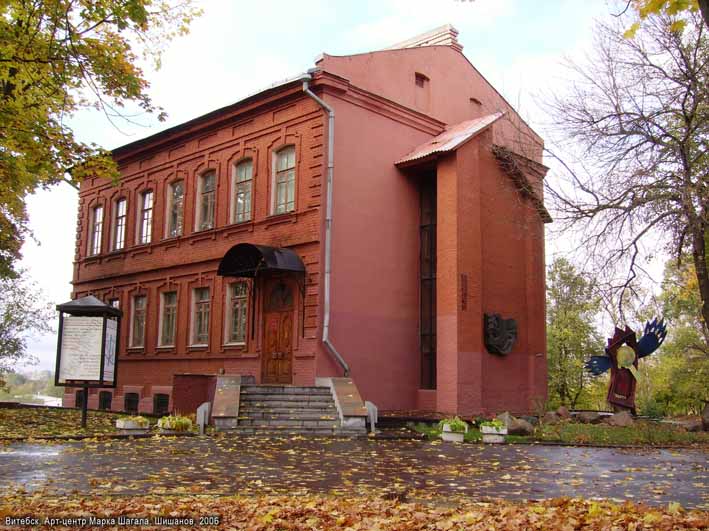
The Marc Chagall Museum in Vitsebsk, Belarus, is dedicated to the life and artistic legacy of the world-renowned painter Marc Chagall. Established in 1997, the museum is situated in the artist's former family home on Pokrovskaya Street, which was built by his father in the early 1900s. The site preserves the domestic environment of Chagall's youth, offering insight into the cultural and social atmosphere of the Jewish quarter in pre-revolutionary Vitsebsk.
The museum houses a significant collection of archival documents, personal belongings, and household items that belonged to the Chagall family. While the primary collection of his original paintings is located at the nearby Marc Chagall Art Center, the house museum serves as a biographical memorial, documenting his early years and the profound influence his hometown had on his later surrealist works.
Key Facts
- Materials
- Wood, Brick
- Civilization
- Belarusian
- Accessibility
- Ground floor accessible
- Date(s)
- 1900s
- Condition
- Restored and active as a museum
- Original Function
- Family residence
- Key Figures
- Marc Chagall
Family Home
1900-1920The house was built by Chagall's father, Khatskl, in the early 20th century. It served as the family home where Marc Chagall spent his childhood and youth before moving to Saint Petersburg and eventually Paris.
Establishment of the Museum
1997The museum was officially opened to the public in 1997, following extensive restoration efforts to return the house to its original state as it appeared during the artist's residence.
Modern Preservation
21st CenturyThe site continues to function as a memorial museum, hosting exhibitions and research initiatives focused on Chagall's early life and the history of the Jewish community in Vitsebsk.
Cultural Significance
The museum is a vital site for understanding the roots of Marc Chagall's artistic vision. By preserving the physical space of his upbringing, it allows visitors to connect his iconic imagery—often featuring motifs of Vitsebsk—to the reality of his early life. It serves as a focal point for international cultural tourism and academic research into the artist's formative years.
Interpretive Notes
Scholarly debates and areas of uncertainty
There is ongoing discussion among art historians regarding the extent to which the museum's interior reconstruction accurately reflects the specific domestic conditions of the Chagall family versus a generalized representation of early 20th-century Vitsebsk life.
Visiting Information
Entry Rules
Open Tuesday through Sunday. Tickets can be purchased at the entrance. Guided tours are available upon request.
Best Times to Visit
Late spring and early autumn offer the most pleasant weather for walking through the historic district surrounding the museum.
Photography
Personal photography is permitted without flash. Professional photography requires prior authorization from the museum administration.
Preservation Notes
Visitors are requested to refrain from touching the artifacts and archival displays. The historic nature of the building requires careful movement through the narrow rooms.
Nearby POIs
2 shownSources & Further Reading
- [1]Marc Chagall: The Russian Years — Aleksandr Kamensky. Rizzoli (1989)
- [2]Chagall: A Biography — Jackie Wullschläger. Knopf (2008)
Key Facts
- Materials
- Wood, Brick
- Civilization
- Belarusian
- Accessibility
- Ground floor accessible
- Date(s)
- 1900s
- Condition
- Restored and active as a museum
- Original Function
- Family residence
- Key Figures
- Marc Chagall