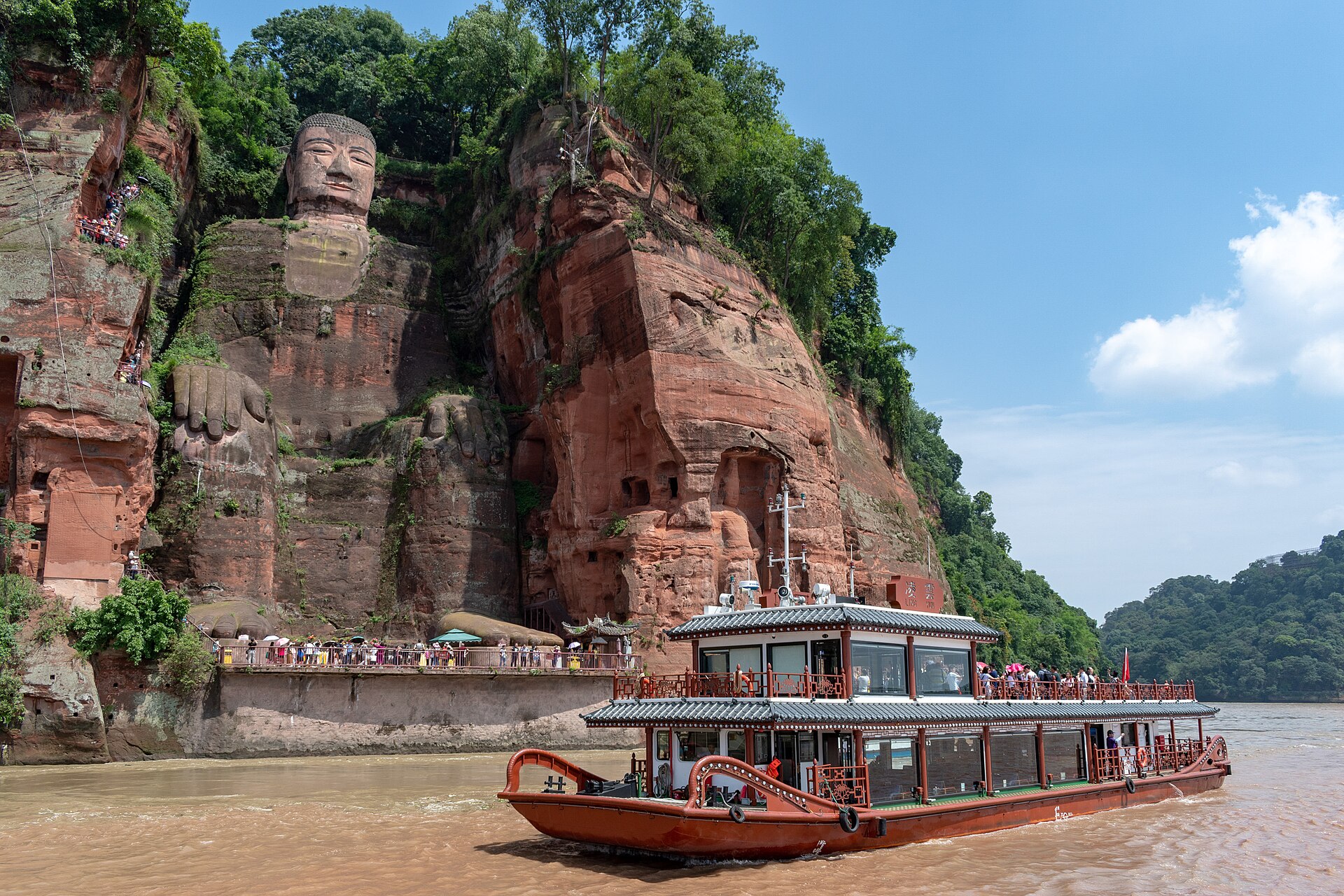
The Leshan Giant Buddha is a 71-meter tall stone statue carved into the cliff face of Mount Lingyun at the confluence of the Min, Dadu, and Qingyi rivers in Sichuan, China. Commissioned by the monk Hai Tong in 713 CE, the project was intended to calm the turbulent waters that frequently caused shipwrecks in the river below. It remains the largest and tallest stone Buddha statue in the world and the tallest pre-modern statue ever constructed.
The statue depicts Maitreya, a bodhisattva often represented as a future Buddha, seated with his hands resting on his knees. The intricate drainage system integrated into the statue—consisting of hidden gutters and channels—has been instrumental in preserving the sandstone structure from erosion and weathering over the past 1,200 years.
Key Facts
- Materials
- Red sandstone
- Civilization
- Tang Dynasty
- Accessibility
- Stairs and cliff paths; boat access for full view
- Date(s)
- 713 CE - 803 CE
- Condition
- Well-preserved, ongoing conservation
- Original Function
- Religious monument and navigation aid
- Key Figures
- Hai Tong, Zhang Choujian, Wei Gao
Conception and Early Construction
713 CEThe monk Hai Tong initiated the project to appease the river spirits and protect local boatmen. He reportedly raised the funds through years of begging. When local officials attempted to seize the funds, he famously gouged out his own eyes to demonstrate his sincerity and commitment to the project.
Completion under Tang Officials
713 CE - 803 CEFollowing Hai Tong's death, construction stalled due to lack of funding. It was later resumed under the patronage of regional military governors Zhang Choujian and Wei Gao, eventually reaching completion after 90 years of labor.
Modern Preservation
1963 - PresentThe Chinese government designated the site as a protected cultural relic in 1963. Extensive restoration work has been carried out to repair the nose, chest, and drainage systems, which are critical to preventing the sandstone from crumbling due to the humid climate.
Cultural Significance
The Leshan Giant Buddha represents the pinnacle of Tang Dynasty religious art and engineering. It serves as a testament to the synthesis of Buddhist devotion and practical civil engineering, reflecting the historical importance of the river trade routes in Sichuan.
Today, it is a major site for both domestic and international pilgrimage and tourism. The statue's presence has transformed the surrounding area into a center for Buddhist study and cultural heritage, reinforcing the region's identity as a sacred landscape.
Interpretive Notes
Scholarly debates and areas of uncertainty
The original appearance of the statue is a subject of ongoing research. Historical records suggest the Buddha was once housed within a massive wooden pavilion known as the 'Great Image Pavilion,' which was destroyed by fire at the end of the Yuan Dynasty. Scholars continue to debate the exact architectural design and scale of this lost structure.
Visiting Information
Entry Rules
Open daily. Tickets are required for entry to the park and the cliff paths. Visitors should be prepared for steep stairs and potential queues during peak holiday seasons.
Best Times to Visit
Early morning or late afternoon to avoid the midday heat and peak tour group congestion. Autumn offers the most stable weather for viewing.
Photography
Personal photography is permitted. Commercial photography and drone usage require prior authorization from the park management.
Preservation Notes
Do not touch the statue or the cliff carvings. Stay on designated paths to prevent erosion of the surrounding sandstone. The site is subject to strict environmental monitoring due to high humidity and acid rain risks.
Nearby POIs
0 shownNo nearby POIs listed yet.
Sources & Further Reading
- [1]Mount Emei Scenic Area, including Leshan Giant Buddha Scenic Area — UNESCO World Heritage Centre. UNESCO (1996)View
- [2]The Leshan Giant Buddha: A Study of Tang Dynasty Engineering — Wang, Y.. Journal of Chinese Cultural Heritage (2015)
Key Facts
- Materials
- Red sandstone
- Civilization
- Tang Dynasty
- Accessibility
- Stairs and cliff paths; boat access for full view
- Date(s)
- 713 CE - 803 CE
- Condition
- Well-preserved, ongoing conservation
- Original Function
- Religious monument and navigation aid
- Key Figures
- Hai Tong, Zhang Choujian, Wei Gao
Nearby POIs
0 shownNo nearby POIs listed yet.