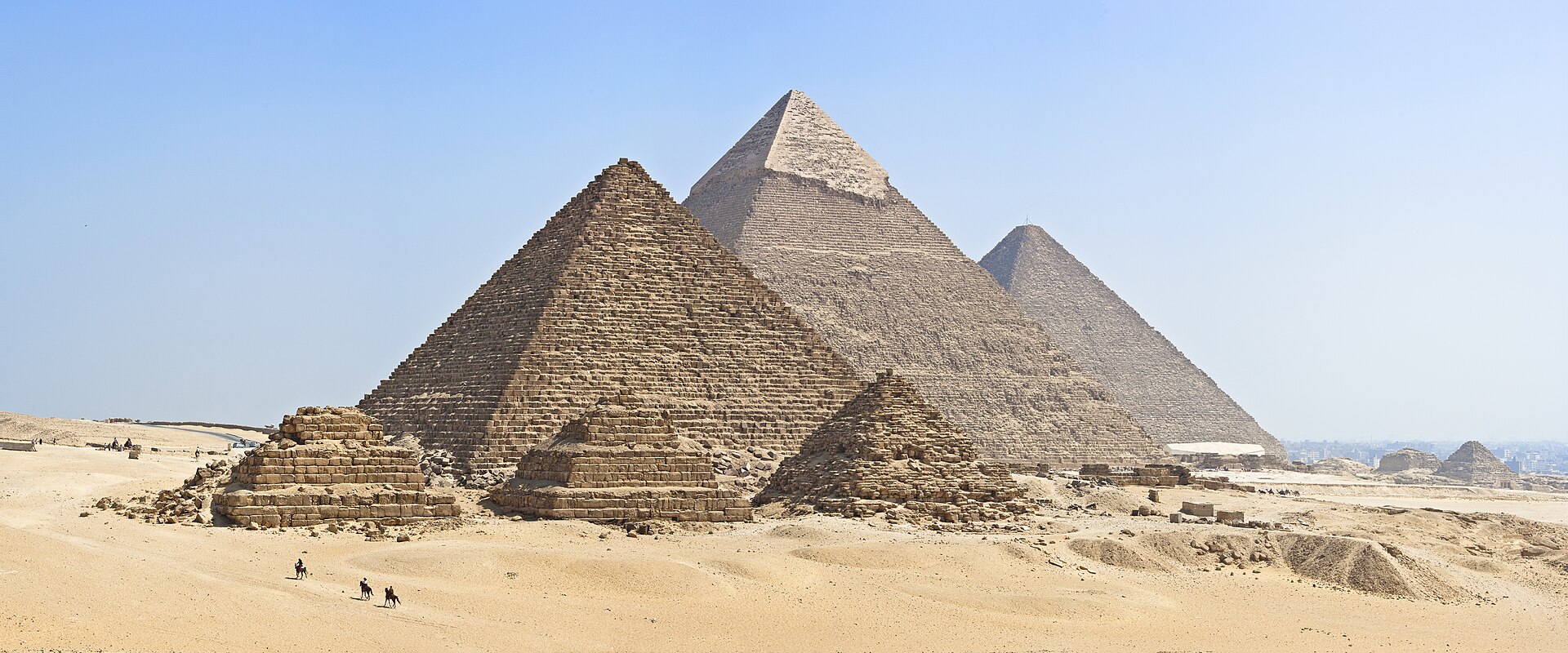
The Giza Necropolis is an ancient funerary complex located on the Giza Plateau near Cairo, Egypt. Constructed during the Fourth Dynasty of the Old Kingdom (c. 2600–2500 BCE), it includes the pyramids of Khufu, Khafre, and Menkaure, as well as the Great Sphinx and numerous smaller tombs. The site served as a royal burial ground and demonstrates the architectural and engineering achievements of ancient Egyptian civilization. It remains one of the most iconic archaeological landscapes in the world.
Key Facts
- Height
- 146.6 meters
- Dynasty
- Fourth Dynasty
- Function
- Royal burial complex
- Location
- Giza Plateau, Egypt
- Major Structures
- Great Pyramid of Khufu, Pyramid of Khafre, Pyramid of Menkaure, Great Sphinx of Giza
- Date(s)
- c. 2600-2500 BCE
- Condition
- Extensively preserved with ongoing conservation
Construction in the Old Kingdom
c. 2600-2500 BCEThe pyramids were constructed as monumental tombs for Pharaohs Khufu, Khafre, and Menkaure. Massive limestone and granite blocks were transported and assembled using advanced engineering techniques for the period.
Later Use and Exploration
Antiquity-19th centuryThe site was visited by ancient travelers and later explored by European archaeologists in the 18th and 19th centuries, leading to systematic excavation and documentation.
Modern Conservation
20th-21st centuriesPreservation efforts address environmental damage, tourism pressure, and urban encroachment. Restoration and research projects continue to refine understanding of pyramid construction methods.
Cultural Significance
The Giza Necropolis is one of the most important surviving monuments of ancient Egypt and a global symbol of antiquity. The Great Pyramid of Khufu is the only surviving structure of the Seven Wonders of the Ancient World. The site reflects ancient Egyptian religious beliefs about the afterlife, royal power, and cosmology.
Interpretive Notes
Scholarly debates and areas of uncertainty
Scholars debate the precise construction techniques used to build the pyramids, including ramp systems and labor organization. Ongoing research also explores workforce composition, logistical planning, and the astronomical alignment of the structures.
Visiting Information
Entry Rules
Ticket required for entry to the plateau. Separate tickets required for interior access to individual pyramids and certain tombs. Security screening enforced.
Best Times to Visit
Early morning to avoid heat and crowds. Cooler months (October–April) offer more comfortable conditions.
Photography
Outdoor photography permitted. Interior photography may require additional ticket or authorization. Drones prohibited without special permit.
Preservation Notes
Do not climb monuments or enter restricted tombs. Follow conservation guidelines to protect fragile stone surfaces.
Nearby POIs
11 shownSources & Further Reading
- [1]
- [2]The Complete Pyramids — Mark Lehner. Thames & Hudson (1997)
Key Facts
- Height
- 146.6 meters
- Dynasty
- Fourth Dynasty
- Function
- Royal burial complex
- Location
- Giza Plateau, Egypt
- Major Structures
- Great Pyramid of Khufu, Pyramid of Khafre, Pyramid of Menkaure, Great Sphinx of Giza
- Date(s)
- c. 2600-2500 BCE
- Condition
- Extensively preserved with ongoing conservation