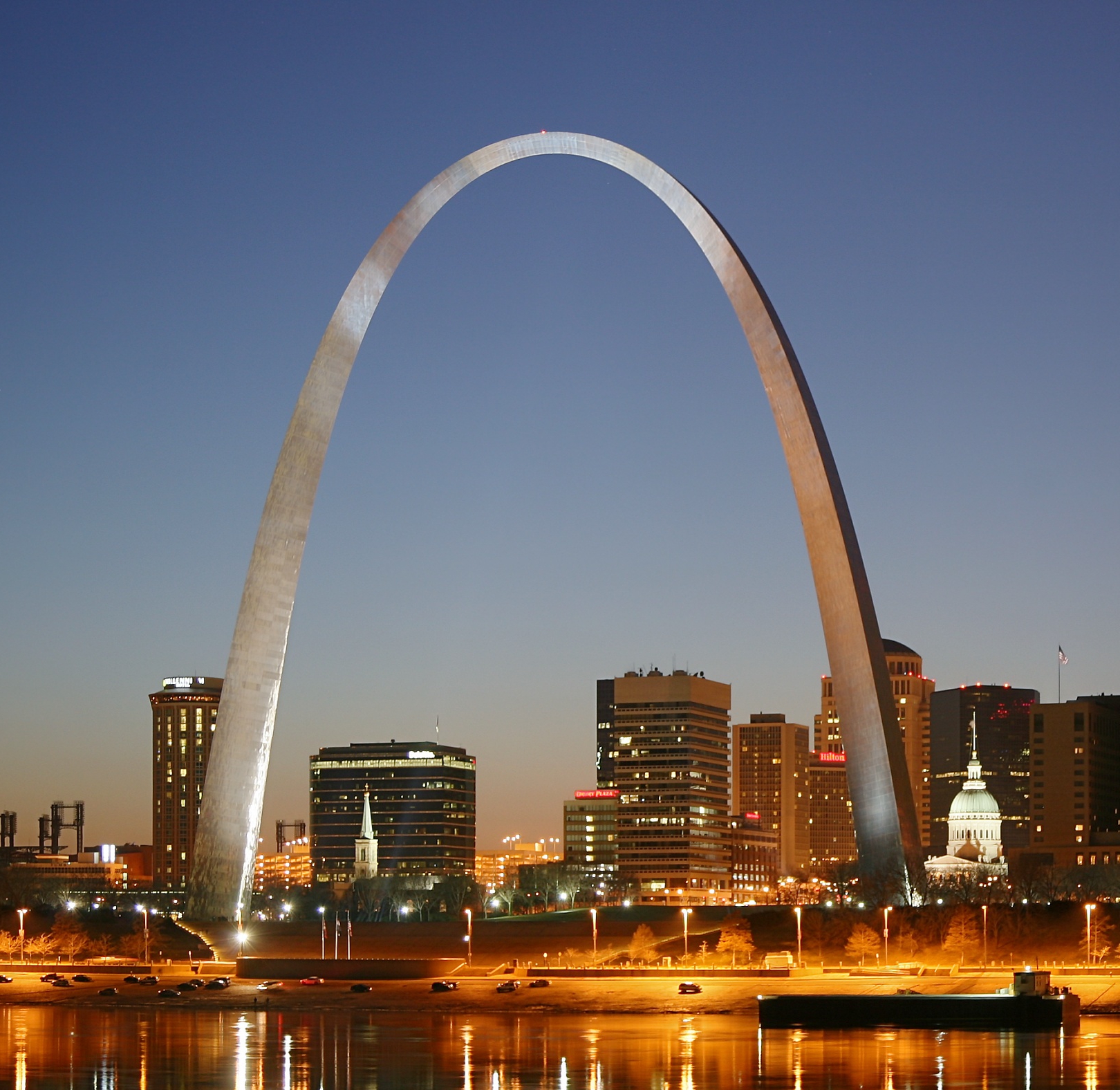
The Gateway Arch is a 630-foot-tall monument located in St. Louis, Missouri, on the west bank of the Mississippi River. Designed by Finnish-American architect Eero Saarinen and structural engineer Hannskarl Bandel, the structure is a weighted catenary arch clad in stainless steel. It serves as the centerpiece of Gateway Arch National Park and commemorates the Louisiana Purchase and the subsequent westward expansion of the United States.
Construction began in 1963 and was completed in 1965, with the monument officially opening to the public in 1967. The arch features an internal tram system that transports visitors to an observation deck at the apex, offering panoramic views of the city and the river. It remains the tallest human-made monument in the Western Hemisphere and a significant example of mid-century structural engineering.
Key Facts
- Materials
- Stainless steel, Reinforced concrete
- Civilization
- United States
- Accessibility
- Visitor center and tram are wheelchair accessible
- Date(s)
- 1963-1965
- Condition
- Well-maintained, active national park site
- Original Function
- Monument to westward expansion
- Key Figures
- Eero Saarinen, Hannskarl Bandel
Conception and Design
1947-1948A national competition was held in 1947 to design a memorial for the St. Louis riverfront. Eero Saarinen's design for a stainless steel catenary arch was selected by the jury, though it faced initial skepticism regarding its structural feasibility.
Construction
1963-1965Construction commenced in February 1963. The two legs were built simultaneously using a specialized derrick system. The final piece was placed on October 28, 1965, completing the arch structure.
Opening and Modern Era
1967-PresentThe observation deck opened to the public in 1967. In 2018, the site underwent a major renovation, which included the expansion of the visitor center and the creation of a landscaped park over the adjacent highway.
Cultural Significance
The Gateway Arch serves as a symbol of St. Louis and the broader American spirit of exploration and expansion. It represents the transition of the United States from an eastern-focused nation to a continental power, marking the starting point for pioneers heading west.
Beyond its historical symbolism, the arch is a landmark of architectural modernism. Its minimalist form and innovative use of materials have made it an iconic feature of the American skyline, frequently appearing in media and cultural representations of the Midwest.
Interpretive Notes
Scholarly debates and areas of uncertainty
Debates have historically centered on the arch's impact on the urban fabric of St. Louis, specifically the displacement of historic riverfront buildings during the initial site clearance in the 1930s and 40s. Additionally, some architectural historians discuss the tension between the arch's abstract, modernist form and its specific role as a commemorative monument.
Visiting Information
Entry Rules
The park grounds are open daily. Access to the visitor center and the tram ride to the top requires a ticket. Security screening is mandatory for all visitors entering the facility.
Best Times to Visit
Weekdays during the off-season (late autumn to early spring) offer the shortest wait times for the tram. Early morning visits are recommended to avoid peak heat and crowds.
Photography
Personal photography is permitted throughout the park and inside the visitor center. Commercial photography requires a special use permit from the National Park Service.
Preservation Notes
The stainless steel exterior is subject to periodic cleaning and maintenance to preserve its reflective finish. Visitors are encouraged to stay on designated paths to protect the surrounding park landscaping.
Nearby POIs
0 shownNo nearby POIs listed yet.
Sources & Further Reading
- [1]Eero Saarinen: An Architecture of Multiplicity — Antonio Román. Princeton Architectural Press (2003)
- [2]Gateway Arch National Park: Foundation Document — National Park Service. U.S. Department of the Interior (2018)View
Key Facts
- Materials
- Stainless steel, Reinforced concrete
- Civilization
- United States
- Accessibility
- Visitor center and tram are wheelchair accessible
- Date(s)
- 1963-1965
- Condition
- Well-maintained, active national park site
- Original Function
- Monument to westward expansion
- Key Figures
- Eero Saarinen, Hannskarl Bandel
Nearby POIs
0 shownNo nearby POIs listed yet.