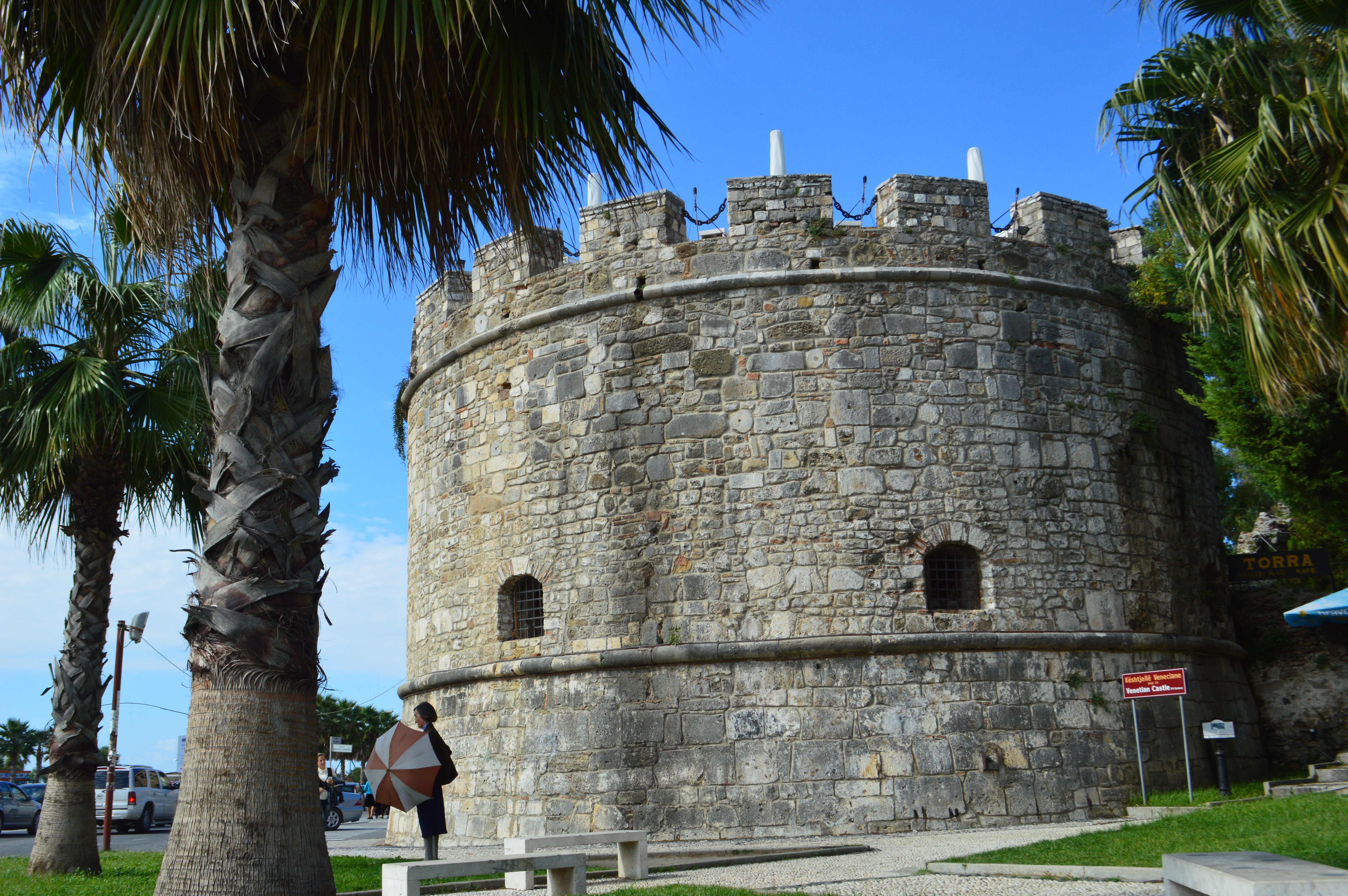
Durrës Castle is a historic fortification located in the port city of Durrës, Albania. Originally constructed in the 5th century during the reign of Emperor Anastasius I, who was born in the city, the fortress served as a critical defensive structure for the Byzantine Empire, protecting the strategic Adriatic gateway.
The site features significant remnants of the original Byzantine defensive walls and a prominent medieval tower, often referred to as the Venetian Tower. While much of the original structure has been integrated into the modern urban fabric of the city, the remaining fortifications provide a tangible link to the city's long history as a major maritime trade hub.
Key Facts
- Materials
- Stone, Brick, Mortar
- Civilization
- Byzantine
- Accessibility
- Accessible from the street level in the city center
- Date(s)
- 5th century CE
- Condition
- Partially preserved, integrated into modern urban landscape
- Original Function
- Defensive fortification
- Key Figures
- Emperor Anastasius I
Byzantine Origins
5th century CEThe castle was commissioned by Emperor Anastasius I to fortify the city of Dyrrachium. The walls were designed to withstand significant sieges and served as the primary defense for the Byzantine presence on the Adriatic coast.
Medieval Expansion
13th-15th centuryDuring the Middle Ages, the fortress was expanded and reinforced by various rulers, including the Normans and later the Venetians, who added the iconic circular tower to improve artillery defense.
Ottoman Period and Decline
16th-19th centuryFollowing the Ottoman conquest of the region, the castle lost its primary strategic importance as a frontier fortification, though it remained in use for administrative and local defense purposes.
Modern Preservation
20th century - presentIn the modern era, the castle has been incorporated into the city's urban plan. Recent efforts have focused on stabilizing the remaining wall sections and the Venetian Tower to preserve them as cultural heritage sites.
Cultural Significance
Durrës Castle represents the historical resilience of one of the oldest cities in Albania. It serves as a symbol of the city's long-standing role as a bridge between the East and the West, reflecting the architectural influences of successive Byzantine, Venetian, and Ottoman administrations.
Interpretive Notes
Scholarly debates and areas of uncertainty
There is ongoing academic discussion regarding the exact extent of the original 5th-century footprint versus later medieval additions, as extensive urban development in the 20th century obscured much of the archaeological context.
Visiting Information
Entry Rules
The site is located in an open public area. The Venetian Tower is occasionally accessible to the public, though hours may vary based on local management.
Best Times to Visit
Spring and autumn offer the most comfortable temperatures for walking the perimeter of the city walls.
Photography
No specific restrictions; photography is permitted in public areas.
Preservation Notes
The site is fragile; visitors should avoid climbing on the ancient masonry. Some sections are located near busy roads and require caution.
Nearby POIs
11 shownSources & Further Reading
- [1]The Byzantine Fortifications of Dyrrachium — Gjerak Karaiskaj. Institute of Archaeology, Tirana (1992)
- [2]Albania: A Guide to the Archaeological Sites — Neritan Ceka. Migjeni Publishing (2014)
Key Facts
- Materials
- Stone, Brick, Mortar
- Civilization
- Byzantine
- Accessibility
- Accessible from the street level in the city center
- Date(s)
- 5th century CE
- Condition
- Partially preserved, integrated into modern urban landscape
- Original Function
- Defensive fortification
- Key Figures
- Emperor Anastasius I