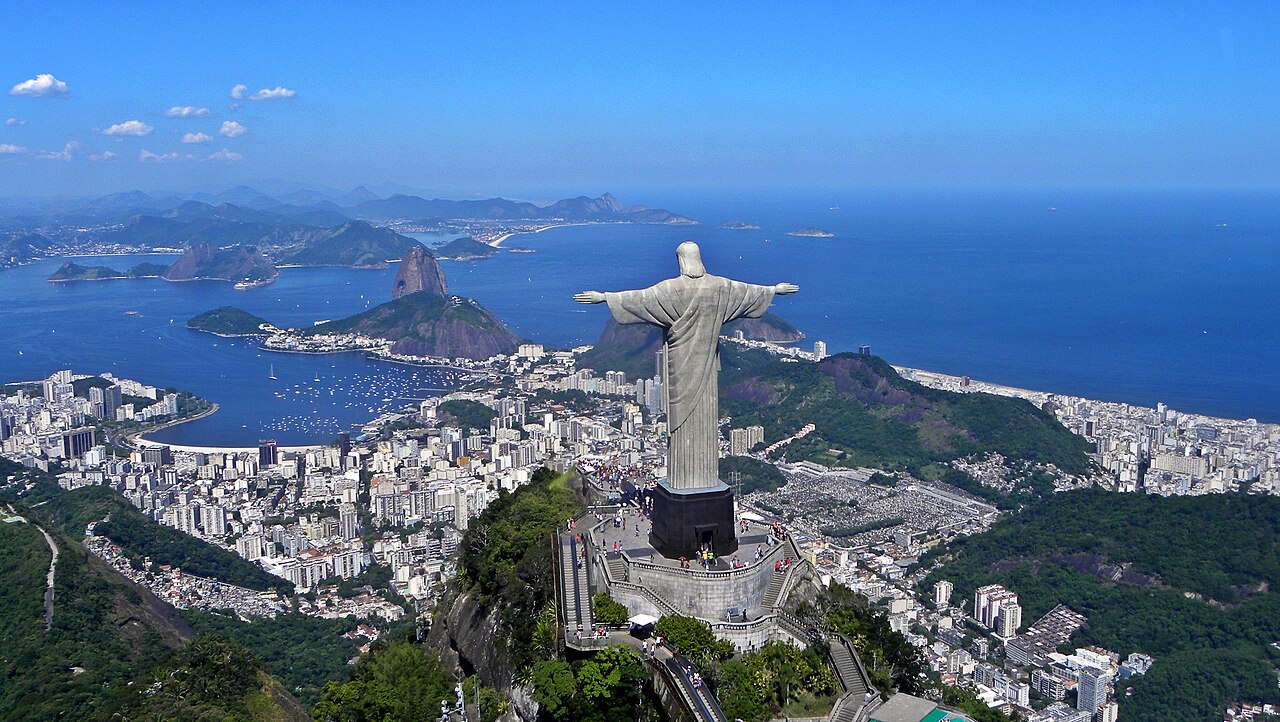
Christ the Redeemer (Cristo Redentor) is a monumental statue of Jesus Christ located atop Corcovado Mountain in Rio de Janeiro, Brazil. Completed in 1931, the reinforced concrete and soapstone structure stands overlooking the city and Guanabara Bay. The monument was conceived as a national religious symbol and engineered by Brazilian and French collaborators. Its Art Deco form, defined by outstretched arms spanning the summit, integrates modern construction techniques with a prominent urban landscape setting.
Key Facts
- Materials
- Reinforced concrete, Soapstone
- Dimensions
- Statue height 30m; pedestal 8m; arm span 28m
- Civilization
- Brazil (First Brazilian Republic)
- Date(s)
- 1922-1931
- Condition
- Standing monument with periodic restoration
- Original Function
- Religious monument and national symbol
- Key Figures
- Heitor da Silva Costa, Paul Landowski, Carlos Oswald
- Architectural Style
- Art Deco
Concept and Fundraising
1920-1922Proposals for a Christian monument on Corcovado date to the 19th century, but the project gained momentum in the early 20th century amid debates about secularism in Brazil. Fundraising was conducted primarily through Catholic organizations and public donations.
Design and Construction
1922-1931Engineer Heitor da Silva Costa oversaw the project, collaborating with French sculptor Paul Landowski for the figure and Carlos Oswald for conceptual design. The statue was constructed using reinforced concrete and clad in triangular soapstone tiles. Transportation of materials up Corcovado relied on the existing railway.
Dedication and National Symbolism
1931The monument was inaugurated on 12 October 1931. It quickly became a symbol of Rio de Janeiro and, more broadly, Brazilian national identity, integrating religious imagery with civic representation.
Conservation and Recognition
Late 20th century - presentRestoration campaigns addressed weathering, lightning strikes, and surface deterioration. The statue lies within the Tijuca National Park, and in 2012 the site was included within the UNESCO designation covering Rio de Janeiro's cultural landscape.
Cultural Significance
Christ the Redeemer functions as both a religious icon and a civic emblem. Its elevated position reinforces themes of protection and spiritual oversight, while its construction during the early republican period reflects negotiations between secular governance and Catholic influence. The monument has become a global representation of Brazil, frequently appearing in diplomatic imagery, international events, and cultural media. Its inclusion within a broader cultural landscape designation links the statue to Rio de Janeiro’s urban and natural topography.
Interpretive Notes
Scholarly debates and areas of uncertainty
Scholars analyze the monument within the context of 20th-century nationalism, examining how religious symbolism was mobilized to shape modern Brazilian identity. Architectural historians also assess the statue’s Art Deco classification, debating the extent to which its stylistic features align with international modernist movements versus localized adaptation.
Visiting Information
Entry Rules
Paid admission required for transport via official train or van services to the summit. Timed entry system in place during peak periods. Managed within Tijuca National Park.
Best Times to Visit
Morning visits reduce cloud cover risk and visitor density. Weather conditions frequently affect visibility; clear days provide unobstructed views. Avoid major holidays for shorter wait times.
Photography
Personal photography permitted. Drone use restricted within national park boundaries without authorization.
Preservation Notes
Surface tiles are sensitive to weathering; do not climb barriers or touch the statue. Lightning protection systems are regularly maintained due to frequent strikes.
Nearby POIs
0 shownNo nearby POIs listed yet.
Sources & Further Reading
- [1]Cristo Redentor — Instituto do Patrimônio Histórico e Artístico Nacional (IPHAN). Official Documentation
- [2]Rio de Janeiro: Landscape Between the Mountain and the Sea. UNESCO World Heritage Centre
- [3]Art Deco Architecture: Design, Decoration and Detail from the Twenties and Thirties — Patricia Bayer. Thames & Hudson
Key Facts
- Materials
- Reinforced concrete, Soapstone
- Dimensions
- Statue height 30m; pedestal 8m; arm span 28m
- Civilization
- Brazil (First Brazilian Republic)
- Date(s)
- 1922-1931
- Condition
- Standing monument with periodic restoration
- Original Function
- Religious monument and national symbol
- Key Figures
- Heitor da Silva Costa, Paul Landowski, Carlos Oswald
- Architectural Style
- Art Deco
Nearby POIs
0 shownNo nearby POIs listed yet.