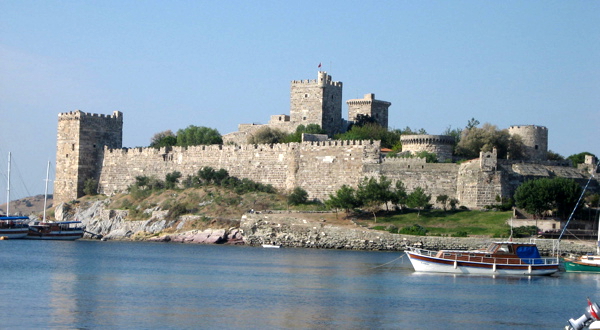
Bodrum Castle, also known as the Castle of St. Peter, was constructed by the Knights Hospitaller of St. John starting in 1402. Situated on a rocky promontory between two harbors, the fortress served as a strategic stronghold for the Order during the Crusades, utilizing stone salvaged from the ruins of the nearby Mausoleum at Halicarnassus.
The structure features five distinct towers—the English, French, German, Italian, and Spanish towers—each maintained by a different national group within the Order. Following the Ottoman conquest of Rhodes in 1522, the castle was ceded to the Ottoman Empire. Today, it serves as the site of the Bodrum Museum of Underwater Archaeology, which houses significant artifacts recovered from ancient shipwrecks in the Aegean Sea.
Key Facts
- Materials
- Green volcanic stone, Marble (reused from the Mausoleum)
- Civilization
- Knights Hospitaller
- Accessibility
- Partially accessible; some areas involve steep stairs and uneven terrain
- Date(s)
- 1402 - 1522 CE
- Condition
- Well-preserved, active museum
- Original Function
- Military fortress and naval base
- Key Figures
- Knights of St. John, Suleiman the Magnificent
Construction by the Knights
1402-1522The Knights of St. John began construction on the site of a former Seljuk fortress. They incorporated architectural elements from the Mausoleum at Halicarnassus, one of the Seven Wonders of the Ancient World, into the castle walls to reinforce the structure.
Ottoman Transition
1522-19th centuryAfter the fall of Rhodes, the Knights surrendered the castle to Suleiman the Magnificent. The Ottomans added a mosque within the walls and converted the chapel into a place of Islamic worship, maintaining the site as a military garrison.
Modern Museum Establishment
1964-presentThe castle was designated as the Bodrum Museum of Underwater Archaeology in 1964. It has since become a world-renowned center for the study of maritime history, housing the Uluburun shipwreck collection and other significant finds.
Cultural Significance
Bodrum Castle represents a unique intersection of Crusader military architecture and ancient history. Its reuse of materials from the Mausoleum at Halicarnassus physically links the medieval period to the classical past, serving as a tangible record of the site's layered history.
For the local community, the castle is the defining landmark of Bodrum. It symbolizes the transition of the region from a contested frontier zone between Christian and Islamic powers to a modern hub of maritime research and cultural tourism.
Interpretive Notes
Scholarly debates and areas of uncertainty
There is ongoing academic discussion regarding the extent of the damage caused to the Mausoleum at Halicarnassus during the castle's construction. While it is confirmed that the Knights used the Mausoleum as a quarry, the precise sequence of the destruction and the degree to which the Knights were aware of the site's archaeological value remain subjects of historical inquiry.
Visiting Information
Entry Rules
Open daily. Tickets are required for entry to the castle and the museum. Visitors are advised to check the official Ministry of Culture website for seasonal hours, as closing times may vary between summer and winter.
Best Times to Visit
Early morning or late afternoon to avoid the intense heat of the Aegean sun, as much of the site is outdoors with limited shade.
Photography
Personal photography is permitted throughout the castle grounds. Flash photography is prohibited inside the museum galleries to protect sensitive artifacts.
Preservation Notes
The castle is a protected heritage site. Visitors must stay on designated paths and refrain from touching the ancient masonry or artifacts. Restoration work is periodically conducted on the towers.
Nearby POIs
1 shownSources & Further Reading
- [1]The Knights of St. John in the Eastern Mediterranean — Jonathan Riley-Smith. Oxford University Press (2012)
- [2]Bodrum Museum of Underwater Archaeology: A Guide — George F. Bass. Turkish Ministry of Culture and Tourism (2015)
Key Facts
- Materials
- Green volcanic stone, Marble (reused from the Mausoleum)
- Civilization
- Knights Hospitaller
- Accessibility
- Partially accessible; some areas involve steep stairs and uneven terrain
- Date(s)
- 1402 - 1522 CE
- Condition
- Well-preserved, active museum
- Original Function
- Military fortress and naval base
- Key Figures
- Knights of St. John, Suleiman the Magnificent