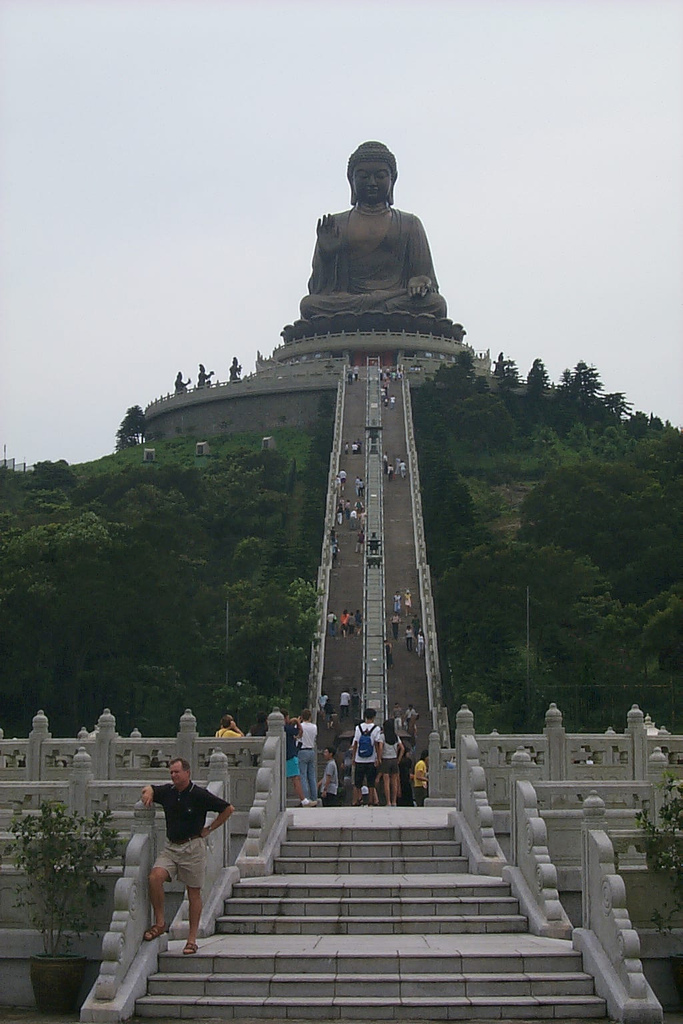
The Big Buddha, also known as Tian Tan Buddha, is a large bronze statue of Amoghasiddhi Buddha located at Ngong Ping, Lantau Island, in Hong Kong. Completed in 1993, the statue sits atop a three-story lotus-shaped pedestal and is surrounded by six smaller bronze statues known as 'The Offering of the Six Devas,' which are depicted offering flowers, incense, lamp, ointment, fruit, and music to the Buddha.
Standing 34 meters tall and weighing over 250 metric tons, the statue is a major center of Buddhism in Hong Kong and a significant tourist attraction. Visitors reach the monument by climbing 268 steps, which leads to a platform offering panoramic views of the surrounding Lantau North Country Park and the South China Sea.
Key Facts
- Materials
- Bronze, Steel frame, Concrete
- Civilization
- Modern Hong Kong
- Accessibility
- Accessible via cable car or bus; final ascent requires climbing 268 steps
- Date(s)
- 1990-1993
- Condition
- Well-preserved, active religious site
- Original Function
- Religious monument and symbol of harmony
- Key Figures
- Po Lin Monastery
Conception and Planning
1970sThe project was initiated by the Po Lin Monastery to create a significant landmark for Buddhism in Hong Kong. The design was inspired by the Altar of Heaven (Tian Tan) in Beijing, leading to its name, the Tian Tan Buddha.
Construction
1990-1993Construction began in 1990 and was completed in December 1993. The statue was cast in Nanjing, China, and required the assembly of over 200 bronze pieces around a rigid steel frame.
Inauguration
1993The statue was officially unveiled on December 29, 1993, with a ceremony attended by monks from across the world and government officials, marking its status as a major regional religious site.
Cultural Significance
The Big Buddha serves as a symbol of the harmonious relationship between man and nature, and between people and faith. It has become an iconic image of Hong Kong's cultural landscape, representing the integration of traditional Buddhist values within a modern, urbanized society. It attracts both devout pilgrims and international visitors, serving as a focal point for spiritual reflection.
Interpretive Notes
Scholarly debates and areas of uncertainty
Discussions surrounding the site often focus on the balance between its religious function and its role as a commercialized tourist destination. Scholars analyze how the monument's placement in a high-traffic tourist area impacts the sanctity of the monastic environment.
Visiting Information
Entry Rules
The site is open daily. Access to the Buddha platform is free, though some interior exhibition areas may require a ticket. Modest dress is recommended as it is a religious site.
Best Times to Visit
Early morning on weekdays to avoid large tour groups and weekend crowds. Clear weather is preferred for the best views of the surrounding mountains and sea.
Photography
Photography is permitted on the exterior grounds and platform. Photography is strictly prohibited inside the exhibition halls within the pedestal.
Preservation Notes
The bronze surface is subject to environmental weathering; periodic maintenance is conducted to prevent corrosion. Visitors are requested to maintain a quiet demeanor out of respect for the religious nature of the site.
Nearby POIs
0 shownNo nearby POIs listed yet.
Key Facts
- Materials
- Bronze, Steel frame, Concrete
- Civilization
- Modern Hong Kong
- Accessibility
- Accessible via cable car or bus; final ascent requires climbing 268 steps
- Date(s)
- 1990-1993
- Condition
- Well-preserved, active religious site
- Original Function
- Religious monument and symbol of harmony
- Key Figures
- Po Lin Monastery
Nearby POIs
0 shownNo nearby POIs listed yet.